
Cecil Beaton: The Man Who Styled His Life

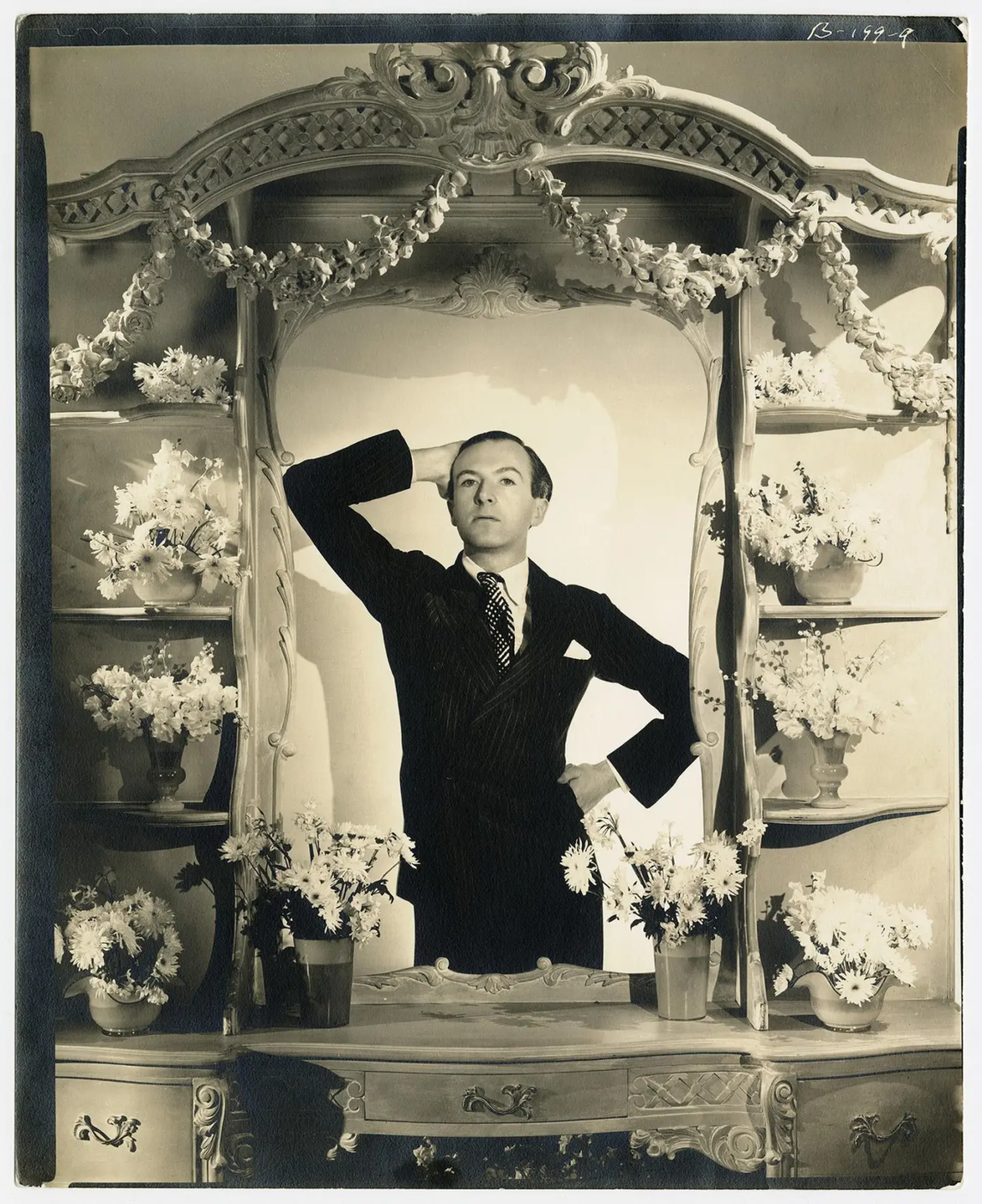
Cecil Beaton’s Fashionable World at the National Portrait Gallery celebrates the photographer, designer and society chronicler whose life was as carefully staged as his photographs.
You can’t spend long with Beaton’s photographs and objects without realising he never waited for beauty to wander into frame. He built it, coaxed it, stitched it, propped it up with cellophane, sequins and even his willing family. Stepping into the National Portrait Gallery’s new exhibition, curated by Robin Muir and Josephine Ross, feels a bit like stepping into Beaton’s dressing room: scraps of fabric, dog-eared letters, cameras, costume sketches, and the ghosts of a thousand parties all humming in the air. You move through his life chronologically, but in truth, time was always the least linear thing about him. He was forever rewriting his own script.

The exhibition opens with a flourish: a large-scale photograph of seven Charles James crinolines, blown up to near human height and set against a French-panelled 18th-century salon, as if Beaton has shrunk you to dollhouse size to prove a point. It’s a dazzling overture that primes you for everything to come — the high-society pegeantry, the Hollywood glamour, the Vogue era, and the wartime grit.
It starts quietly, with a boy in Hampstead who turned his sisters, Baba and Nancy, into stars long before any editor took note. There they are on the wall: posed against makeshift backdrops, swathed in whatever the Beaton household could cough up – lace curtains filched from the parlour, hats teased into shape, props made of tissue and glue. His mother sits in some of the early portraits too, gamely indulging him. You get the sense that even as a teenager, he wasn’t documenting a family so much as directing one.
His first camera — a battered Kodak 3A, on display in a vitrine — looks modest enough, but Beaton handled it with the fervour of someone discovering a true calling. Letters beside it reveal how desperately he wanted entry to a world of glamour he hadn’t been born into. Later, Cambridge didn’t work out — he was far too interested in amateur theatricals to sit through anything so dreary as lectures — but the Bright Young Things did: a ready-made cast of eccentrics, alongside high-society figures whose glamour needed no exaggeration. His diaries, full of self-mythologising, insecurities, and the odd razor-sharp aside, show just how hard he rehearsed the version of Beaton the world eventually applauded.

Society portraits form the next great swell in the exhibition, and this is where Beaton truly hits his stride. Princess Marina, Duchess of Kent, surveying the world with chilly grace; Lady Diana Cooper looking like she’s about to step into a dream sequence; Mrs Harrison Williams, chin set at an angle that tells you she always got her way — hardly surprising for a woman who would marry five times, including to the American tycoon Harrison Williams and later to Count Eddy de Bismarck, two of the richest and most influential men of their era. The curators have hung Paula Gellibrand — Beaton’s ethereal favourite, the society beauty and model known in London circles as ‘the Gilded Girl’ — with particular drama. She floats through her frames like a spectral Vogue goddess.


Then the exhibition makes a tonal swerve: war. The photographs grow grittier. We’re so used to the froth of Beaton’s images that it’s easy to forget he risked far more than his reputation during the Second World War. Prominently displayed is his famous image of a bombed three-year-old, Eileen Dunne, her head wrapped in bandages, clutching a doll. It became a Time magazine cover and a symbol of Britain’s resilience. It’s heartbreakingly direct.

Beaton didn’t take them from a safe remove. He hitchhiked on night flights, rode in ambulances, and stood on rooftops photographing the fires of the Blitz. He travelled to North Africa, India, China and Burma — often in active war zones — to document troops and local communities. There’s danger baked into these images, though he still, occasionally, can’t resist arranging a soldier the way he’d pose a duchess: pilots standing like models, crisp uniforms and charisma on full display. Even in these frontline moments, the ones he caught on film bear the unmistakable stamp of Beaton’s artistic sensibility.
The exhibition segues into Beaton’s professional life with Vogue. Here, you see the machinery behind the magic: framed covers, contact sheets, costume sketches, and letters revealing the contracts that kept him busy throughout the 1920s, ’30s and ’40s.

Before the exhibition moves on to Hollywood and My Fair Lady, it stops at a small stand about the episode that nearly ended Beaton’s American career. You see the 1938 Vogue illustration in which he slipped an anti-Semitic phrase, and the brisk, furious letter from the editor that followed. The impact is immediate. Beaton apologised and insisted the line didn’t reflect his views, but the damage was swift. Commissions disappeared, New York closed its doors, and the world he had been so determined to enter simply dropped away. What the exhibition suggests, without hammering the point, is that this was the moment he had to rebuild — theatre design, costume work (his My Fair Lady hats alone deserve a shrine), and the late-career portrait commissions in which he softened, just slightly.
Hollywood arrives like a warm gust of Technicolor. Here are the gowns, the glamour, the portraits of stars who understood the value of a Beaton treatment: Audrey Hepburn, Marlene Dietrich and, of course, Marilyn Monroe. The Monroe images — luminous, fragile, desperately self-aware — are a reminder that Beaton saw things others missed. He wrote of her “stunning paradoxes”, and you can see him trying to pin down all those shimmering contradictions in a single frame.

The exhibition dedicates a corner to My Fair Lady, with colour transparencies of Audrey Hepburn in his costumes, sketches, and stills from the set. He won Academy Awards for costume design, and the exhibition underlines the dazzling precision and care behind each frame — Hepburn poised mid-step in a swathe of silk, the world a little brighter for his orchestration.

What’s impressive about this exhibition is how many sources it’s drawn from — private family collections, the NPG archive, the V&A, Condé Nast, the Imperial War Museum, the Royal Collection — a reminder of how ubiquitous Beaton once was.
Walking out, I felt as though I’d spent time with someone who understood, long before Instagram or “personal branding”, that life could be curated, edited, embellished — and that there was no shame in a bit of theatre if it got you where you wanted to go.
For Beaton, the truth was always negotiable, but the effort was sincere.
The exhibition runs at the National Portrait Gallery until the 11th of January 2026.
https://www.npg.org.uk/whatson/exhibitions/2025/cecil-beaton/.

Elena Leo is the Culture & Lifestyle Editor of Ikon London Magazine.


