
Review – Fish Bowl by Compagnie le Fils du Grand Réseau at the Peacock Theatre

★★★★ Wordless comedy at the Peacock Theatre, where neighbours live hilariously close for comfort.
Is sharing space enough to keep loneliness at bay? How much of our life is shared with our neighbours? In Fish Bowl, the question barely needs asking. From the moment the lights rise on the exposed apartment block designed by Laura Léonard, the answer is already in full view. The show is co-written by the three performers — Guillois, L’Huillier and Martin-Salvan — and directed by Guillois himself.
Three Parisian attic flats sit side by side, their interiors permanently exposed. The stage around them is noticeably larger than the flats themselves, the architecture intentionally reduced to force proximity. The rooms keep the characters pressed together. On the left, Olivier Martin-Salvan occupies a pristine white cube, a shrine to minimalism and technology. His toilet slides in and out of the wall at the clap of a hand; rubbish disappears down a chute. In the centre, Pierre Guillois lives in a narrow, box-like space stacked with cardboard, barely wide enough for his elongated frame. On the right, Agathe L’Huillier inhabits a pink studio thick with fabric, cushions and a fish bowl.

The set is one of the production’s strongest elements, because it feels accurate. Built by Atelier JIPANCO with the technical team at Le Quartz, Scène nationale de Brest, it allows the action to move quickly between moments, weather and moods without stopping the flow.
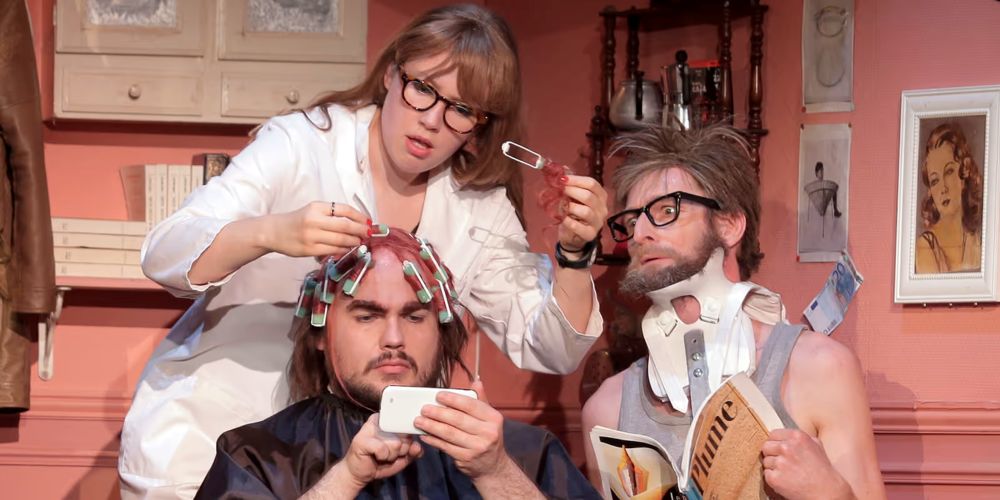
Life bleeds easily between the flats. Cooking, sex, repairs, medical procedures, bad haircuts — all of it happens in full view. A goldfish is accidentally poisoned with cleaning chemicals, setting off a chain reaction across the building. A pan catches fire and is extinguished by a jet of water bursting unexpectedly through the wall from next door. Bin bags fly. Underwear ends up airborne. A rooftop sunbathe turns into exposure when L’Huillier flashes her breasts at a passing helicopter, while Guillois becomes an unwilling voyeur.
The corridor turns into shared territory. Party scenes spill into it, dramas unfold there; it briefly links three separate spaces into something resembling a collective home rather than three sealed boxes, to which the characters eventually retreat.

It is a Molière Award–winning production, and its humour sits close to silent film: physical timing, things going wrong, bodies embarrassed by objects and by each other. Many jokes are allowed to run longer than is comfortable, and that discomfort is part of how the show works.
Music marks the emotional phases the characters themselves never articulate. When two of the neighbours fall into a relationship and begin occupying each other’s space with confidence, Happy Together plays with full optimism. Later, after the relationship collapses and the third neighbour is left alone in his narrow flat, All By Myself fills the room with loneliness — and occasional laughter when it is sung in gibberish.
There is no dialogue. Everything is done through movement, timing and the constant management of space. Martin-Salvan trusts automation until it fails him. Guillois moves carefully, negotiating his own limbs in a room that seems to resist him. L’Huillier fills her apartment with cooking, sunbathing, having sex loudly enough for both neighbours — and the audience — to follow every development.
Some of those developments prove too much for certain audience members. The show fully indulges its fondness for bodily-function humour. Characters relieve themselves noisily in the toilet, the sound travelling freely through all apartments and into the theatre. Martin-Salvan’s clap-activated toilet finally rebels in the closing moments, erupting and spraying brown liquid everywhere — life literally turning to merde amid emotional collapse.
It is not all party and laughter. In its absurd way, Fish Bowl also touches on serious subjects. The blonde leaves the trio, pregnant by a mysterious fourth character, only to return later with a baby — crying, depressed, back in her tiny flat. In a stark scene on the roof, she stares into the dark void, one step away from throwing herself into the abyss. The same roof that once promised sunbathing and escape suddenly offers something far more final.
The strength of this inventive, fast-moving show is that it lets serious things surface almost by accident. It becomes difficult not to think about where love ends, where friendship begins, and what remains once everyone has seen too much. In a world that feels vast compared to these cramped lives, it is hard not to ask whether sharing space is enough to keep loneliness at bay.
BIGRE / “Fish Bowl” runs at the Peacock Theatre until 31 January
Tickets from: £18.00
https://www.sadlerswells.com/whats-on/le-fils-du-grand-resaeu-fishbowl/#book

Elena Leo is the Culture & Lifestyle Editor of Ikon London Magazine.


