
Stations of Life: An Immigrant Artist Fills the Empty Windows of a London Church at Easter

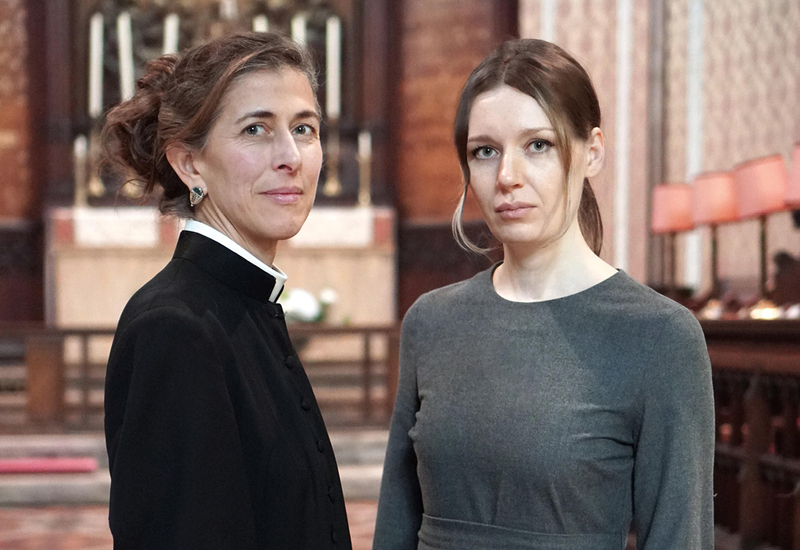
The windows of Emmanuel Church in West Hampstead have stood empty since World War Two. This Easter, they are filled with stained glass works shaped by scripture and parishioners’ stories, after Reverend Catriona Laing opened the church to a contemporary project.
During the opening night this Easter, violet light spills across stone and glass, shifting slowly through the interior as visitors move between the works now installed in those spaces. It is the height of the liturgical season, and the church feels altered: a faint scent of violets replaces the usual incense, and music carries lightly through the nave. Along the walls and inside the window frames, stained-glass panels catch the light in fragments, filling gaps that have long remained unfilled.

The artist, Anna Kiparis, stands barefoot to one side of the nave, watching as the congregation and guests move through a sequence of images and objects shaped as much by personal testimony as by the biblical narrative they rework. Kiparis created Stations of the Cross: Stations of Life, a series of fourteen stained-glass works installed inside the church, some replacing the missing windows, shaped by conversations with the congregation and made possible by the Reverend Catriona Laing, who opened the church to the project.
These interpretations of familiar scenes, from Christ’s condemnation to his burial, are reframed through the lived experience of congregation members, drawing on stories of abandonment, care, collapse and endurance.
How does an immigrant artist enter a Church of England congregation and help turn one of Christianity’s central narratives into a shared contemporary language?
Becoming Part of the Church
Kiparis was born in Russia and trained as an architect at the Moscow Architectural School (MARCH), where she studied in a joint programme with London Metropolitan University. Before the pandemic she was already working internationally, with projects abroad and plans to establish her own practice.
That trajectory shifted in 2020, when she gave birth to twins during the Covid-19 pandemic, followed by isolation and an extended period of family life in Russia. Her architectural work paused. After the start of the war in Ukraine, she left Russia, moving first through a period of uncertainty before eventually settling in the UK on a Global Talent visa. The application followed a series of projects in Russia and abroad, including commissions for the Nikola-Lenivets park, collaborations with the Theatre of Nations, and an installation in her parents’ country house garden during the pandemic, when travel and studio work were restricted. The same project was later shown internationally and recognised by institutions including the Canadian Museum for Human Rights.
She first entered Emmanuel Church almost by chance, stepping inside one afternoon out of curiosity and staying for the service. She did not yet understand the liturgy, but kept coming back anyway. At first she sat at the back, observing more than taking part. Over the following weeks she began to linger after services, then joined conversations in the church hall, then shared in readings of the Bible with members of the congregation. Gradually, the distance between watching and participating narrowed. Teaching drawing to children at the church became part of her routine, alongside a return to drawing as a way of processing what she was hearing and seeing. She also began singing in the church choir, a practice she continues.

The idea developed in late 2025, when Kiparis and the Reverend Catronia Laing began planning the church’s programme for Lent. What followed during the season itself were a series of shared Bible readings and informal gatherings with members of the congregation, where passages were read aloud and then opened into conversation. These discussions often moved away from the text into lived experience: stories of hardship and unexpected forms of support that some people interpreted as divine intervention. Kiparis listened to them and later returned to these accounts as material for the work. It was through this process that she arrived at the idea of structuring the project around fourteen Stations of the Cross.
“People shared moments of crisis and recovery,” Kiparis says. “In the end there were exactly fourteen of them — like the stations. That’s where the idea of personal stations came from.”
One woman spoke about losing her teenage son; another described taking in a homeless child after her own family broke apart. These accounts were not treated as testimony in any formal sense, but formed part of an ongoing exchange between artist and congregation, gradually shaping the work.
From this material, Kiparis began to translate lived experience into the language of the Stations of the Cross. In Pilate washing his hands, she sees a figure of responsibility and withdrawal, a gesture of refusal and distance. The fall of Christ under the cross becomes, in her reading, a moment of isolation rather than punishment — the scene in which Christ’s cry, “My God, why have you forsaken me,” expresses absolute loneliness.
A triptych titled Helping Hands brings together figures who intervene along the way — Mary, Simon of Cyrene, Veronica wiping Christ’s face. Here, intervention becomes a form of presence rather than doctrine, a way of describing how help appears and is carried between people.
Station of Anna
The project also grows out of Kiparis’s own biography. A recurring thread in her work is female experience. In Portrait of Daughters, inspired by the lamentation of the women of Jerusalem, grief is shown as shared endurance rather than individual mourning, with Mary, Veronica and Sarah placed within the same composition.
“It is about carrying loss and still holding love,” she says.
In the Lady Chapel, Kiparis installed a nursing Madonna with two infants, a work that comes out of her experience of early motherhood during the pandemic.

It was the Reverend Catriona Laing who made the project possible, opening the church to a contemporary work.
“She allowed an immigrant artist with limited English into the heart of the church,” Kiparis says. “And opened the space to contemporary work.”
A grant for the Emmanuel Church project was initially approved, then withdrawn while installation was already underway. Kiparis describes it without drama: “I decided it was my cross to carry.”
The project was completed regardless.
After the opening, Kiparis stood at the pulpit and read out testimonies from members of the congregation. In the months before, the same space had been used for Bible readings and conversations that moved away from scripture into personal stories and lived experience.
She says reading the testimonies did not feel like a conclusion, but the closing of a chapter in a bigger process, her own exploration of faith and spiritual experience, which continued beyond the project itself.
“I didn’t arrive at faith in a traditional sense, but I did regain faith in people.”
After the exhibition, the works will be gone and the windows will be bare, but what remains is the stories shared inside the church and the life of the congregation around Emmanuel Church.
Kiparis continues to return each Sunday to sing in the choir, in a church filled with Light.
Anna’s website: https://annakiparis.co.uk/
Emmanuel Church, West Hampstead: https://www.emmanuelnw6.com/
Cover image: Reverend Catriona Laing (L) and artist Anna Kiparis (R) at Emmanuel Church, West Hampstead.

Elena Leo is the Culture & Lifestyle Editor of Ikon London Magazine.


