
Monster review – a fierce, unsettling study of girlhood and guilt

What becomes of a society that breeds its own monsters — and still dares to call them children?
Written by Abigail Hood and directed by Kevin Tomlinson, Monster draws not on one notorious case but several — from Mary Bell to the boys who killed James Bulger — stories that still haunt the national memory. It’s not a play about murder alone but about the conditions that create it: homes built on fear, classrooms without boundaries, the social blind spots where compassion fails. The monster on stage stares back at us, asking what kind of society looks away while a child is turning monstrous. When care suffocates, when love neglects, when institutions collapse into silence — who bears the blame?

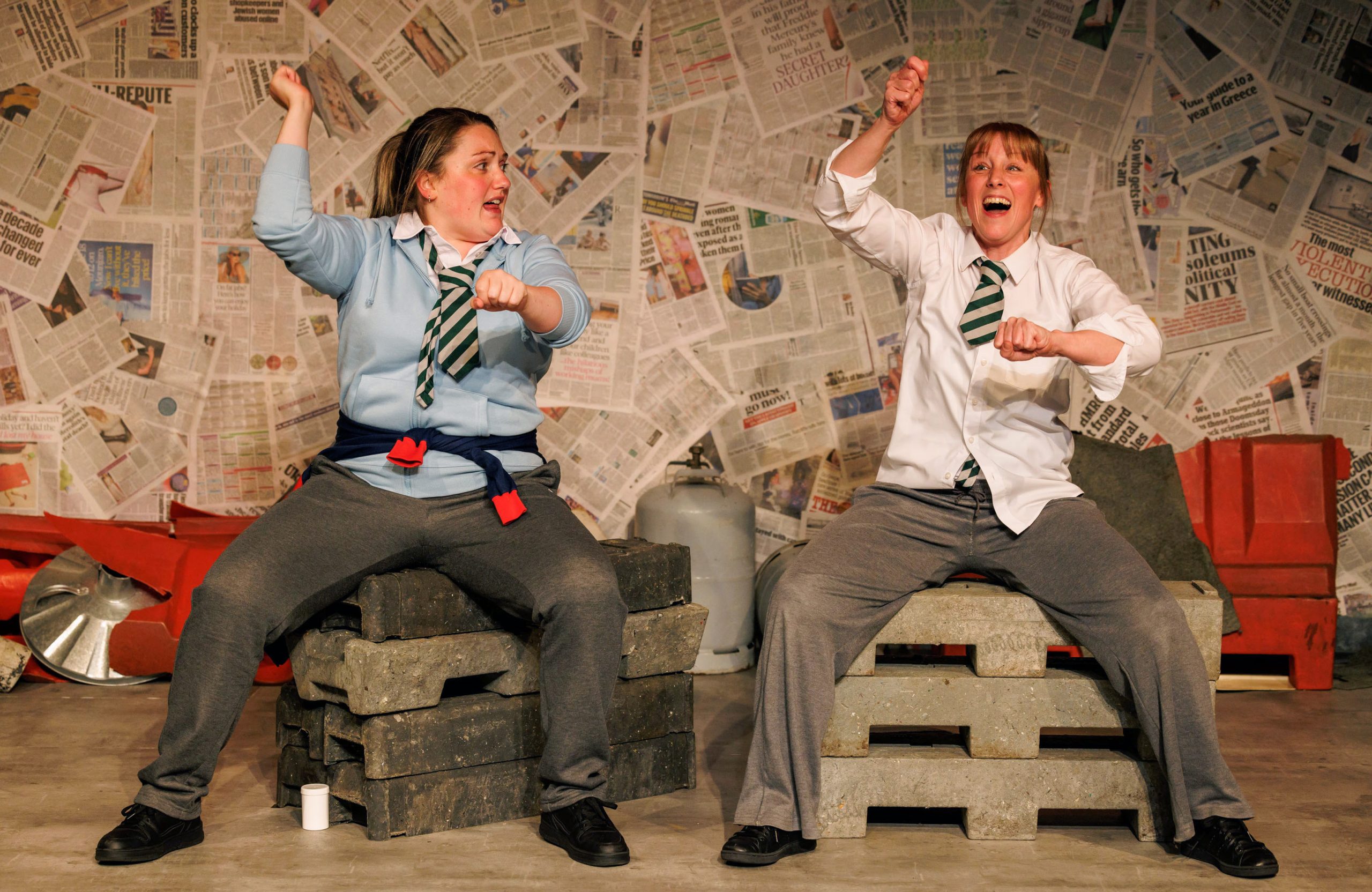
In a dumping ground at the edge of town — cracked concrete, a broken bathtub, a traffic cone tipped on its side — two schoolgirls linger after class. Their grey-and-white uniforms blend with the debris. A tyre swing turns slowly, a pipe lies half-buried in the dirt: the only shelter they have. This isn’t a playground but a graveyard for what’s been discarded, and that includes them. Here, Kayleigh Grey (Abigail Hood) and Zoe Douglas (Lauren Downie) test what it means to belong. They flirt, spar, and dream about running away to the Isle of Muck — a fantasy island that promises freedom but smells faintly of myth. Their Glaswegian banter is fast, rude, and far too knowing for their years.
Kayleigh’s mother Hazel (Sarah Waddell) staggers on high heels through the wreckage of her own existence, in a black leather miniskirt and cheap pink spaghetti-strap top — a sex worker surviving on instinct and drink, clinging to control in the only way she knows. Having once given Kayleigh away, she’s taken her back under terms that are barely spoken but fully understood. When a client asks for someone younger, Hazel sends her daughter.

Hazel’s voice is coarse, her reasoning practical to the point of cruelty. “You can only rely on me,” she tells her daughter. Kayleigh’s dry response — “Then I’m truly fucked” — lands like a truth too sharp to laugh at. Hood writes her not as a caricatured villain but as a woman trapped in a moral collapse so deep she can no longer see it.
At school, Miss Rebecca Hastie (Lisa Ellis), the young English teacher, notices the bruises and the brittle defiance. She’s idealistic, sincere, a survivor of her own teenage violence. Her husband, Stevie Hastie (Steve Hay), a painter, prefers stillness and denial. “You can’t save them all,” he tells her — a line that echoes like an alibi. But Rebecca can’t let go. Her care becomes entanglement, her empathy a risk.

When Zoe falls pregnant — a careless night with a boy from the estate — and Rebecca gives birth soon after, Kayleigh finds herself abruptly abandoned, left outside the circle of care she mistook for love. The shift is subtle but fatal. Their old hiding place — the rusted pipe where the girls once shared cigarettes and secrets — becomes a site of desperate invention. Kayleigh takes Rebecca’s baby, Rosie, intending to show her to Zoe, to play house, to prove she can be gentle.
The violence happens on stage but inside that pipe. We don’t see the act itself — we see Zoe’s face as she peers in, her shock tightening into horror. We hear the sirens, the cries, the red pulse of light. Rebecca’s infant is dead. Kayleigh, fifteen, steps from the pipe as if crossing from one life into another — blank, lost, and already condemned.
Act Two opens thirteen years later, on Brighton beach, just before midnight. The sound of the sea replaces the industrial hum. Kayleigh is now Tracey — older, calmer, her accent softened by time. She has a steady partner, John Parker (Kevin Tomlinson, quietly superb), who’s ready to propose. The scene glows with the illusion of normality, yet guilt never sleeps. When he asks her to share a secret, she jokes, then spits it out: “Who could ever love the monster?” The line isn’t self-pity — it’s survival turned to habit.
Back in Scotland, Rebecca and Stevie Hastie visit the grave of their daughter. Grief has become ritual for her; he’s moved on, remarried, rewritten the story to make it bearable. When Rebecca learns that Kayleigh has returned — summoned by Hazel’s cancer — the past reopens like an old wound.

Hazel’s deathbed scene is one of the play’s most harrowing. Frail, head wrapped in a scarf, she still spits venom: “You were born a monster.” Waddell delivers it not as a curse but as family lore — the kind of cruelty that passes for honesty. It recalls Mary Bell’s mother, yet Hood refuses melodrama. The horror lies in the ordinary.
Rebecca meets Kayleigh — now Tracey — at Hazel’s funeral. Their encounter, bereaved mother and child-killer, could tip into theatrics, but Hood writes it with restraint that hurts more. Rebecca doesn’t scream. She asks questions that can’t be answered. Tracey doesn’t beg forgiveness. She explains, haltingly, that she didn’t mean to kill Rosie. When Tracey lifts her own daughter, Phoebe, Rebecca freezes. How can life continue in the same hands that once took it?

Tomlinson’s direction grounds everything in quiet realism. Scene changes happen almost invisibly — a turn of light, a sound cue, a breath. Felix Walter’s set turns refuse into atmosphere, reconfiguring itself across years without losing its bleak poetry. Aaron J. Dootson’s lighting follows the emotional temperature — harsh white playground light fading into bruised reds and soft seaside greys. Sound design carries much of the storytelling: the nostalgic pop of “It’s Not Unusual” fading into thumping dance anthems, the echo of waves, a distant siren. Each transition punctuates the shifts between worlds — childhood, punishment, uneasy peace.
The six-strong cast carry the play’s moral weight with startling precision. Hood gives Kayleigh a jittery, brittle energy — the body of someone who’s always ready to flinch. Downie’s Zoe is all tenderness and confusion, her silences charged with memory. Ellis’s Rebecca balances compassion and disbelief with aching truth. Waddell’s Hazel is unforgettable — a study in practical cruelty, masking guilt with cheap perfume. Hay’s Stevie Hastie catches the male quiet that so often shelters complicity. Tomlinson, as John Parker, brings warmth and steadiness — the one hint that peace might be possible.
Years later, on the date they once promised — 06.06.2026 — the girls meet again. Older now, carrying different lives, they talk the way they used to — half-joking, half-honest — until Zoe says quietly that she would still follow Kayleigh, wherever she went. The words hang there, echoing through everything that came before. It’s not forgiveness, more a circle of trust closing, fragile but intact.
Monster ends in silence, not redemption. The pipe, the playground, the child — all still there, changed but not erased. It’s a reckoning with the long loop of harm: neglect breeds injury; injury becomes violence; violence leads to exile; exile circles back to the wish to belong. What emerges isn’t a story of forgiveness but of endurance — how people live with what they’ve done, and how others live with what’s been done to them.
The production’s partnership with Advance, the charity supporting women affected by domestic abuse and sexual violence, isn’t an afterthought but an extension of its argument. It grounds the work in the real, in the unseen daily aftermath that stories like this are made from.
Monster is hard to watch because it insists on watching back.
★★★★☆
Unsettling, superbly acted, and heartbreakingly believable.
Author: Abigail Hood
Company: Veritas Theatre Company and KEPOW! Theatre Company
Venue: Seven Dials Playhouse, London
Dates: 24 September – 18 October 2025
Tickets: Seven Dials Playhouse Box Office
Featured photo: Benkin Photography

Elena Leo is the Culture & Lifestyle Editor of Ikon London Magazine.


