
While They Were Waiting review — Gary Wilmot’s absurdist debut finds humour in the act of waiting

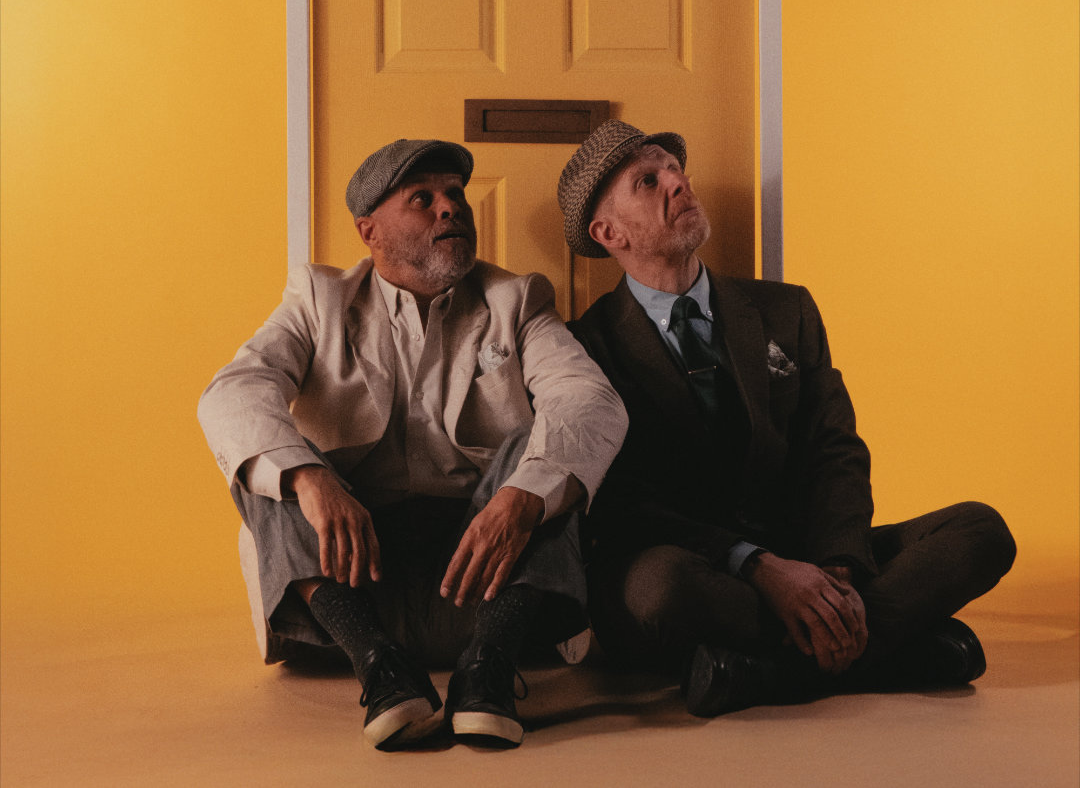
Gary Wilmot’s first play pairs him with Steve Furst in a gently surreal two-hander about friendship, mortality and the strange human pastime of waiting.
The origin of While They Were Waiting is itself a story about waiting. Gary Wilmot and Steve Furst met while working together at the National Theatre, where long stretches backstage between cues prompted the idea of a play about the curious human habit of waiting. The result is a ninety-minute two-hander now playing Upstairs at the Gatehouse in Highgate, a small Off-West-End venue above a pub that suits the production’s intimate scale.
The set immediately establishes the play’s dreamlike tone. Designer Hannah Danson creates a landscape that feels theatrical and faintly unreal: a bright yellow door at centre stage, a bench, scattered crates, a vintage portable record player and clusters of plants. Four cartoonishly fluffy clouds float against an impossibly blue sky. Bathed in warm golden light, the scene evokes a curious mix of tropical afternoon, childhood illustration , and the saturated skies of the Technicolor era.
. The programme notes mention Cuba as inspiration, though visually the effect might equally suggest a Wes Anderson palette or the surreal calm of a Magritte painting.

Into this strange in-between place steps Mulberry, played by Steve Furst. Dressed in a heavy brown three-piece suit with trilby, briefcase and an umbrella missing its canopy, he presses the bell beside the yellow door and sits down to wait. Soon he is joined by Bix, played by Wilmot, whose loose linen clothes, straw Panama hat and relaxed warmth form a deliberate contrast to Mulberry’s fussiness.
For most of the play’s running time, the two men simply talk. Their conversation moves through wordplay, philosophical digressions and playful arguments about language. A discussion about waiting turns into musings about the nature of time; a debate about sandwiches becomes a linguistic puzzle about why two sausages in bread are called a “sausage sandwich.” It has the flavour of two intelligent friends several drinks into a late-night conversation, batting ideas back and forth and trying to outdo each other with the next observation.
The contrast between the performers sustains much of the piece’s rhythm. Furst’s Mulberry is angular, pale and nervy, a man who clings to rules and definitions as if they might keep the world orderly. Waiting, he insists, is his favourite hobby. Wilmot’s Bix is softer in every sense: relaxed posture, generous smile and bottomless optimism. Their physical differences mirror their personalities, and the pair share an easy rapport that keeps the extended dialogue engaging.

At first Mulberry dominates the exchanges, correcting Bix’s language and insisting on how things should be done. Gradually, however, the dynamic shifts. Beneath Mulberry’s pedantic control lies anxiety. Eventually he admits the truth: he is dying.
What follows reframes everything we have been watching. Bix is not simply a cheerful stranger but a guide — an angel of sorts, though without wings or halo — there to help Mulberry pass through the door. The mysterious entrance that has loomed throughout the play becomes less a puzzle than a threshold.
There is a genuinely moving moment when Bix reads an “Ode to a Friend,” a reflection on shared memories and the quiet ways friendships drift apart as time passes. The play’s theme sharpens here: waiting is not merely an empty pause between events but part of life itself.

Director Sydney Stevenson leans gently into the production’s absurdist influences. Comparisons with Beckett are inevitable — two men waiting before an enigmatic object will always recall Waiting for Godot — but Wilmot’s script ultimately pursues a warmer tone. The play also flirts with metatheatre, acknowledging the audience directly and even explaining the concept of the “fourth wall.”
Not everything lands evenly. The philosophical exchanges occasionally drift into repetition, and some of the linguistic wordplay stretches a joke slightly further than necessary. At ninety minutes without an interval, the play sometimes circles its ideas rather than advancing them.
Yet what carries the evening is the performers’ connection. Furst’s tightly wound Mulberry slowly unravels, revealing genuine fear beneath the irritation, while Wilmot’s Bix remains calm and reassuring, guiding both his companion and the audience toward the play’s final revelation.
By the end, the yellow door no longer suggests a barrier but a passage. The play may spend much of its time contemplating the act of waiting, but its real subject is the moment when waiting ends — and the strange mixture of fear, curiosity and acceptance that follows.
For a modest Off-West-End production, While They Were Waiting is an imaginative and thoughtful piece, elevated by two experienced performers clearly enjoying each other’s company. Audiences expecting a conventional plot may find themselves, like the characters, waiting for something more concrete to happen. Those willing to follow the play’s meandering philosophical path may discover that the journey itself is the point
Written by Gary Wilmot
Starring Gary Wilmot and Steve Furst
Directed by Sydney Stevenson
Produced by Chromolume in association with Nikki Newman
WHILE THEY WERE WAITING
Upstairs at the Gatehouse
26 February to 22 March 2026

Elena Leo is the Culture & Lifestyle Editor of Ikon London Magazine.


