
Meet the four photographers behind the National Portrait Gallery’s shortlisted portraits

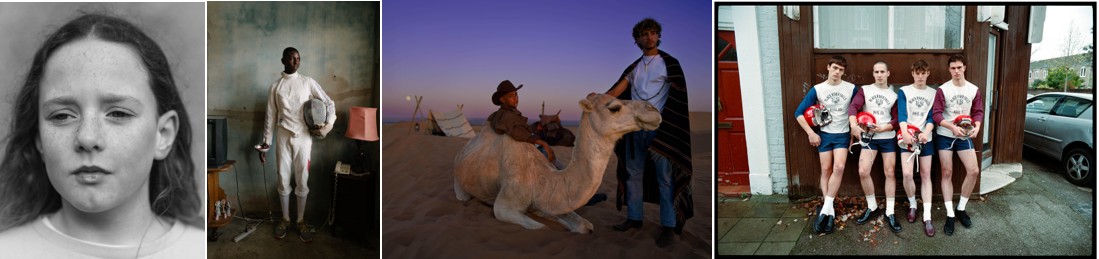
A teenage fencer in Cuba, an imagined cowboy scene in Morocco and a mysterious child in a Devon village are among the four photographs competing for this year’s prize.
Four photographers have been shortlisted for the 2026 Winston Taylor Photo Portrait Prize at the National Portrait Gallery, selected from 3,977 entries by 1,338 photographers.
The four shortlisted pictures couldn’t be much less alike. One was made during a five-minute encounter in a Cuban family home. Another puts four men in American football kit outside a suburban building. A third turns an artists’ residency in Morocco into a deliberately staged Western. The fourth began when its photographer stopped to photograph fog near Plymouth.
The winner, announced on 3 November, will receive £15,000. A further £3,000 will go to second place and £2,000 to third, while one of the shortlisted photographers will also receive an £8,000 commission for a new work for the National Portrait Gallery.
Here are the four photographers behind the shortlist.
James Clifford Kent

Neisser, Pinar del Río, Cuba, from Yuma
James Clifford Kent has been photographing in Cuba for around 20 years, having first gone there while teaching at the University of Havana.
He met Neisser, a 16-year-old aspiring pentathlete and fencer, while working on a documentary in Pinar del Río in 2025. The teenager was photographed in his family’s living room, still wearing his fencing uniform.
The scene is remarkably ordinary: a television, ornaments and a tangle of telephone wires sit behind him, while daylight enters through open shutters. The contrast between the pristine white fencing kit and the domestic setting gives the portrait much of its tension.
Kent, who is self-taught, says the photograph came from an impromptu five-minute conversation and is the most emotional image he has made in his 20-year career.
Marcie Docherty

PE, from In Pursuit of Muscle
Four men stand outside a suburban building wearing American football kit. Except they aren’t quite dressed as an American football team.
Their helmets and jerseys are mixed with wrestling shorts, sports socks and polished shoes. The deliberately awkward combination is central to Marcie Docherty’s ongoing exploration of how masculinity is constructed and performed.
Docherty, a BRIT School and Central Saint Martins graduate, works with analogue film and has a particular interest in photographic archives and the ways images carry social histories.
PE borrows the familiar visual language of American sport, but puts it somewhere it doesn’t quite belong.
Katie Hitchcock-Smith

Moroccan (Amazigh) Cowboys, from Tajine Westerns
Katie Hitchcock-Smith’s photograph started with a cowboy hat.
During an artists’ residency near Erfoud in eastern Morocco, she arranged a Western-themed shoot with two people she had met there. The hat came from home; other props were bought locally.
Mohmed sits on a camel, cigarette in hand, while Nour wears jeans, boots and a white T-shirt beneath an Amazigh marriage blanket. The image deliberately evokes the world of John Wayne, Clint Eastwood and old cigarette adverts, while the Moroccan setting keeps disrupting the fantasy.
Hitchcock-Smith’s practice is interested in the way images of travel and adventure circulate between cultures. Here, the Western is less a place than a collection of visual clichés to be played with.
Max Pattenden

Havannah, Lee Moor, from Men May Come and Men May Go, But I Go On Forever
Max Pattenden found the setting for his shortlisted portrait almost by accident. The 24-year-old photographer was driving near Plymouth when he stopped to photograph fog and came across Lee Moor, a village on the edge of Dartmoor.
He began spending time with the community, eventually meeting ten-year-old Havannah at a Halloween gathering. He later photographed her around the village.
She looks towards the camera with an expression that is difficult to read. Behind her is the distinctive landscape created by Lee Moor’s long history of China clay mining.
Pattenden became interested in photography through fashion marketing before studying at the University of Plymouth. He also took part in the National Portrait Gallery’s Photo Portrait Now project while at university.
The four shortlisted photographs will be shown alongside 52 other works by 52 photographers at the National Portrait Gallery from 5 November 2026 to 17 January 2027.
National Portrait Gallery, St Martin’s Place, London WC2H 0HE. 5 November 2026–17 January 2027.
Tickets are available to purchase at https://www.npg.org.uk

Elena Leo is the Culture & Lifestyle Editor of Ikon London Magazine.


