
The Boy at the Back of the Class review — a children’s adventure with a national argument at its heart

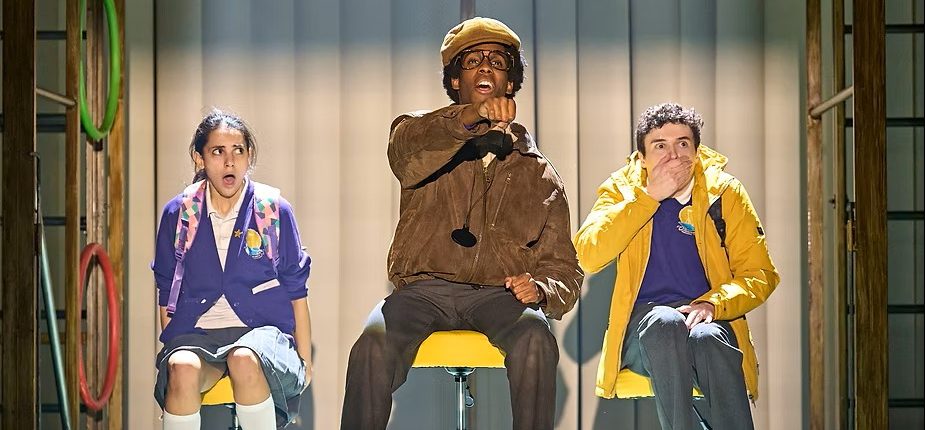
★★★★☆ – Nick Ahad’s adaptation of Onjali Q. Raúf’s bestselling novel returns to the Rose Theatre with warmth, energy and an unapologetically clear moral centre.
On press night at the Rose, the atmosphere felt less like a theatre premiere and more like the end of term. Rows of schoolchildren buzzed, pointed at the empty chair on stage, whispered theories before the lights went down. When the cast burst in, the auditorium was already theirs.
Nick Ahad’s adaptation of Onjali Q. Raúf’s novel keeps the story direct. A new boy, Ahmet, takes the seat at the back of a Year 5 classroom. He doesn’t speak, he doesn’t smile, he won’t even eat a sherbet lemon offered by his well-meaning classmate Alexa. Through her — played with bright, steady intelligence by Sasha Desouza-Willock — we learn he is a refugee from Syria, separated from his parents. Alexa decides this is intolerable and begins to organise what the children proudly describe as their greatest plan yet. It also turns out that Ahmet is brilliant at football — that most universal language of playground diplomacy — and the skill becomes a bridge, drawing him into the group before words fully can.
The cast, all adults, commit fully to the physical life of nine-year-olds. They scramble up gym bars, whisper conspiratorially, collapse into giggles and indignation with convincing momentum. Kloé Dean’s movement direction captures that restless classroom energy: someone is always climbing, interrupting, or hatching the next impulsive scheme.

Photo Credit: Manuel Harlan
Serkan Avlik’s Ahmet is largely silent in the first act, absorbing everything. His stillness gives the character weight, though at times the physical awkwardness edges towards something overdrawn, leaving you uncertain whether you are watching trauma, shock or a stylised choice. The theatrical shift when he begins speaking English is deft. We understand that, in his own mind, he has always been fluent — speaking Kurdish clearly and fully — but the world has not understood him. When he gasps, “Why can nobody understand me?” and then turns to ask the audience whether we understand him, children in the stalls shout back “Yes!” without hesitation. It is the evening’s most affecting moment.
The story does not disguise its politics. Prejudice, displacement and kindness are clearly signposted. At points the message feels loudly narrated rather than fully dramatised. Some adult roles — a hostile teacher, unguarded parents at the school gate — are drawn broadly, almost grotesquely, pushing the tone towards caricature. There is no ambiguity about where the moral centre lies.
Yet the balance holds more often than it falters. Alexa’s grief over her father’s premature death quietly shapes her instinct to protect Ahmet. Brendan the Bully, played with exuberant physical menace by Max Jordan, is not simply cruel; we glimpse the source of his hostility at home. The children’s plan to reunite Ahmet with his family unfolds with perfectly childlike logic. They write to the Queen, quickly decide Royal Mail cannot be trusted to deliver the letter in time, and attempt to hand it over in person during a London school trip. The miscalculation lands them briefly detained, splashed across the news, and inadvertently turns Ahmet into the most visible refugee in the country — if only for the short spin of the news cycle. In this distinctly modern twist, television and social media succeed where formal channels stall. The Queen replies. The Home Office responds with a favourable decision. The mechanism is undeniably fairy-tale in structure, but it lands because it is filtered through the children’s absolute conviction that institutions can be persuaded to act decently.

Photo Credit: Manuel Harlan
Lily Arnold’s design is spare but clever. Gym frames anchor the stage and, with shifts in light, become bus stops, market stalls, Tube carriages and palace gates. The space is open, sometimes almost bare, yet Ryan Day’s lighting fills it with colour and atmosphere so it never feels thin.
At times the moral simplicity borders on the laboured and can feel like an argument carefully assembled for its audience. But the sincerity of Ahmet’s story cuts through that framing. When he describes what he has lost, the auditorium goes very still. It is difficult not to feel compassion — and a certain discomfort at how recognisable his fear sounds.
The response on the night was undeniable. The children were rapt, then jubilant, then on their feet. The mayor was present, the red carpet rolled out, and the atmosphere carried the buoyant optimism of a community event.
Adults will find enough craft and humour to stay engaged, but this works best as a shared experience with children. It will send families home talking — about fairness, about refugees, about what responsibility looks like in practice. The play’s moral position is clearly and confidently argued on stage. For some, that clarity will feel reassuring; for others, it may provoke debate. Either way, the conversation it begins may matter as much as the story it tells.
Runs until 22nd February at Rose Theatre
Running time: Approx. 2hrs incl. interval
Age guidance: 7+ All children over the age of 18 months requre their own ticket
Rose Theatre Kingston
24–26 High Street, Kingston upon Thames, KT1 1HL, United Kingdom


Elena Leo is the Culture & Lifestyle Editor of Ikon London Magazine.


