

New technology for glasses means they automatically focus on you.
For anyone who struggles with distance vision and focusing on objects close up, you’ll know the frustration of either having to swap between different glasses or use multifocal lenses.
Since the introduction of the first commercial progressive lens in 1959, lens manufacturers have invested substantial efforts and resources in reducing the distortion and discomfort associated with them. Advancements in technology have been marginal and mostly centered around better production technologies and incremental decreases in distortions between segments.

Technological progress has been restricted by the inherent trade-off in the current multifocal lens technology between the spectrum of viewing distances and the blind spot/distorted area of the lens. Deep Optic’s technology eliminates this trade-off, and for the very first time, allows a wide spectrum of viewing distances with no distortion – none what so ever.
However, a new technology is being tested that could remove the need to ever change between distance and reading glasses ever again.
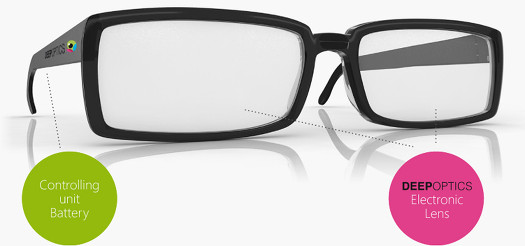
Deep Optics, an Israeli-based firm, has come up with a pair of smart glasses that can sense where the wearer’s eyes are trying to focus, and adjust the strength of the lenses accordingly.
The dynamic lenses have two sensors built into the frame which constantly measure the pupils and eye movement, which changes when we try to focus on objects at different distances.
A small processor also in the frame then works out the optics needed in the lens to give sharp vision at that distance and communicates with the lenses to change their strength. This is possible because of a layer of liquid crystal built into the lenses, which can change the amount of light they let in, and how it bends through the lens. This provides the level vision strengthening needed.
Deep Optics co-founder Yariv Haddad told the MIT Technology Review: “The user doesn’t have to control it, doesn’t have to look through a specific area of the lens.
“[They] just have to look through the glasses as they would with any glasses prior to that.”
Deep Optics say the process is silent, as well as automatic and are continuing to work on a prototype of the product. There is no word yet on if and when the technology, which they call Omnifocals, will become available.


