
REVIEW: THE UGLY ONE AT ARCOLA THEATRE – ★★★★

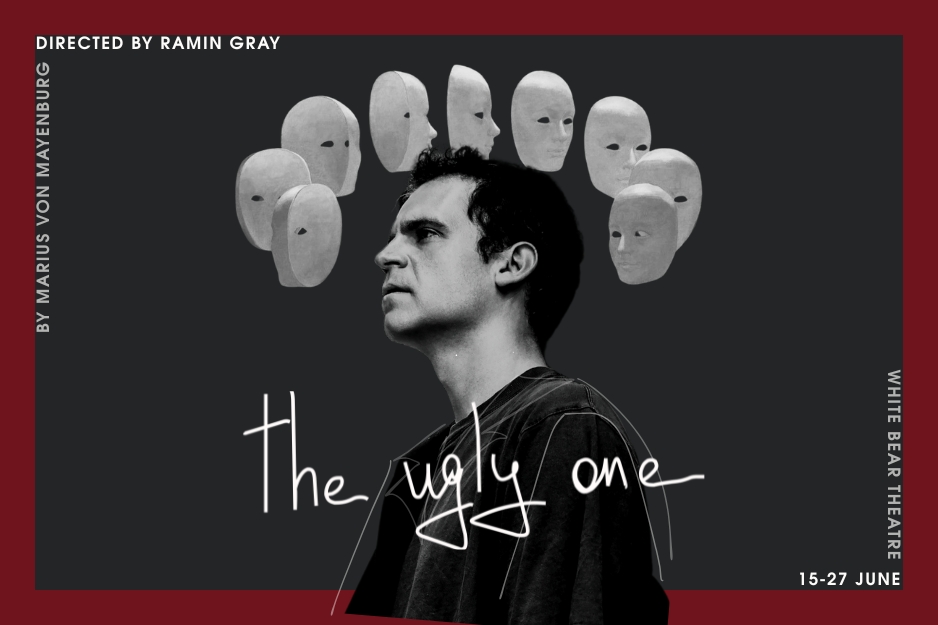
Marius von Mayenburg’s deliciously absurd comedy about cosmetic perfection, social conformity and interchangeable identities gets an intimate, stripped-back treatment from Ramin Gray, powered by a nimble four-strong ensemble.
Do you like your face? Do other people like it? Would life be radically different if you transformed overnight from being exceptionally unattractive into a Greek god lookalike? Would you suddenly enjoy the privileges of a Hollywood A-lister? And, more importantly, would a beautiful face give you a beautiful life?
Long before Kardashian before-and-after photographs became internet fodder, inspiring the deliciously cruel meme “You’re not ugly, you’re just poor”, German playwright Marius von Mayenburg was already asking what happens when beauty can be bought, manufactured and, ultimately, mass-produced. His play The Ugly One (2007) is a deliciously sharp comedy about the price of physical perfection.
Meet Lette, a young engineer so “unbelievably ugly” that his own boss, Scheffler, decides to send a colleague, Karlmann, to present Lette’s ingenious new plug-and-socket invention instead. The invention is perfectly sound; the face presenting it, apparently, is not.
The solution to getting ahead in life, it turns out, is not to work harder or become better at your job. It’s to get a new face. Von Mayenburg sends his hapless protagonist to another Scheffler: a plastic surgeon. A new face brings Lette an intoxicating, previously unimaginable level of pretty privilege. Colleagues adore him, women queue up to sleep with him, and even his wife, Fanny, becomes enamoured with Lette 2.0.
It’s all fun and games until the surgeon starts producing copy after copy of Lette’s face. In a world where your beauty is no longer unique, what becomes of the privileges it once conferred? And if everyone can have your face, what exactly is left of you?

Von Mayenburg demonstrates a remarkable ability to embed complex philosophical questions within deceptively witty dialogue, interrogating the fragility of individual identity, the pressures of social conformity and the extent to which human worth is constructed through physical appearance and external validation.
Director Ramin Gray approaches the play through the concept of Poor Theatre, developed by Polish theatre director Jerzy Grotowski, and takes its principles to heart. Poor Theatre places the relationship between actor and audience above elaborate scenery, expensive costumes and technical spectacle. It strips theatre back to its essentials, demanding that actors use their physical presence, movement and imagination to compensate for the absence of conventional theatrical resources.
The execution is almost startling in its simplicity. The Arcola’s studio space has no conventional stage. The playing area is marked out with duct tape, with the audience seated around three sides. You can hardly get closer to the action. Some of the auditorium lighting is left on, further dissolving the boundary between performers and spectators and creating a sense of shared space.
The set consists of little more than a collection of chairs. The actors wear their own everyday clothes, with no elaborate costumes to distinguish the characters. Four performers double up to play eight roles, switching identities sometimes in the middle of a sentence. The only notable theatrical prop in Lette’s transformation scene is a blue plastic bag, pulled over his head to represent the surgical bandages.
In a play about the tyranny of appearances, Gray cleverly strips away appearance itself, leaving us to consider how much of what we see is really in our heads.
With this directorial approach, there is always a danger that actors might overcompensate for the lack of staging. Not so here. The ensemble of four — Michael Tcherepashenets, Anastasia Velique, German Segal and Dan Wolff — deliver the 55 minutes with an appealing lightness and simplicity. Their performances have an effortless, almost conversational quality. Watching them is rather like joining a group of friends at a pub, listening to them recount an increasingly outrageous story over a Sunday roast.


German Segal plays Lette. The young actor has been developing an onscreen career, with appearances in Channel 4’s The Undeclared War, the BBC’s Wolf Hall: The Mirror and the Light and, most recently, Silent Witness. Interestingly, his Lette doesn’t change much in terms of physical mannerisms as his face changes. It is his voice that undergoes a transformation: his accent is noticeably more Eastern European at the beginning, becoming increasingly British once he acquires his “proper face”.
Michael Tcherepashenets has a face for the screen and a voice for the radio, with a wonderfully deep American drawl. He plays two men who wield considerable power over Lette’s life: his boss, Scheffler, sharp, ruthless and casually dismissive of Lette’s feelings and professional worth; and the plastic surgeon, a smooth, self-assured salesman of beauty, whose honed skills allow him to exercise power in a rather more literal way — by cutting flesh and manufacturing perfection. Tcherepashenets plays both men with effortless authority, giving each a different flavour of arrogance: impatient and dismissive as the boss, charming and almost seductive as the surgeon.
Anastasia Velique brings great precision to all three of her roles, moving effortlessly between Lette’s wife Fanny, the nurse and another Fanny, the wealthy 73-year-old CEO of Nukleartik. Her transformation as the wife is particularly enjoyable: initially almost maternal and slightly condescending towards Lette, she turns into an adoring, enthusiastic worshipper once he acquires his new face. The older Fanny is herself a cosmetic surgery enthusiast, a manufactured beauty whose wealth and sexual appetite have long since dispensed with any moral compass. Together with her son, another Karlmann, she pursues Lette both in the bedroom and the boardroom, giving the audience some of the play’s more outrageous comic episodes.


Dan Wolff plays both Karlmanns and makes the two characters nicely distinct. As Lette’s colleague, he is at the mercy of the boss and happy to benefit from his promotion, seemingly treating Lette’s humiliation as just another little piece in the puzzle of professional success. His second Karlmann, the son of the wealthy Fanny, is a rather different creature: slightly camp, unmistakably a mummy’s boy, spoiled and seemingly without much personal direction. He does what mother says because mother, naturally, knows best. Their family dynamics erupt in a hilariously outrageous incestuous scene. If the subject can ever be joked about, von Mayenburg pushes the absurdity of human obsession to its limits.
Wolff is a great acquisition for Broken Nose Theatre Company. His body language and gaze are almost hypnotic, and he has an extraordinary stage presence.
Almost twenty years after it was written, von Mayenburg’s satire has lost none of its bite. If anything, in the age of Instagram faces, cosmetic enhancements and the relentless pursuit of the perfect image, it feels more pertinent than ever. What happens when your face, your job, even your identity can be replicated? What makes you irreplaceable? Gray’s production takes us towards these darker questions, culminating in an abrupt ending.
But the question remains: can you lose yourself and then find yourself again in somebody else’s face? Or is there an abyss from which there is no return?
The Ugly One runs at Arcola Theatre until 19 December 2026.
Address: 24 Ashwin Street, Dalston, London E8 3DL.
Tickets £20–£29.
Running time: 60 minutes.
Age guidance: 16+.
Booking and information: https://www.arcolatheatre.com/event/the-ugly-one/

Elena Leo is the Culture & Lifestyle Editor of Ikon London Magazine.


