
Review: Fagin – Hero or Villain? at Circle & Star Theatre, Hampstead

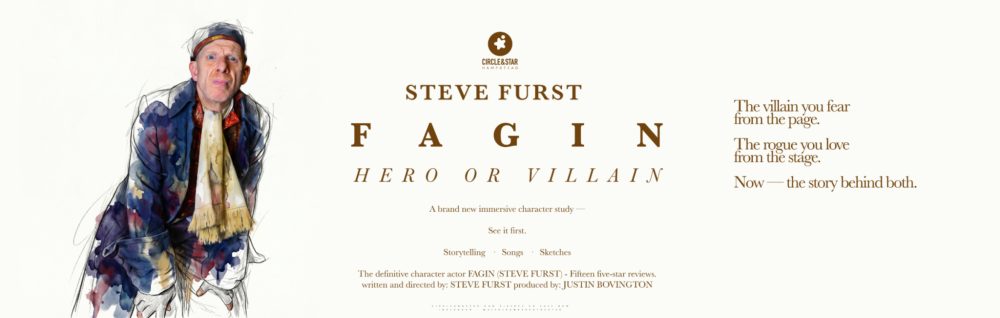
Part theatre, part storytelling, Steve Furst’s one-man show examines how generations of performers have reshaped Dickens’s Fagin.
Is Fagin Dickens’s criminal mastermind, Lionel Bart’s irresistible rogue, or a figure whose identity has shifted with every major interpretation? Steve Furst’s Fagin – Hero or Villain? builds its evening around that question, tracing the character’s journey from Victorian novel to musical theatre through the eyes of an actor who has lived with the role.
Written, directed and performed by Furst, this one-man show combines theatre, storytelling, music and literary history in the intimate surroundings of Hampstead’s newly revived Circle & Star Theatre. The venue, formerly Pentameters, has found fresh purpose under Furst and his creative team, its programme extending beyond traditional fringe theatre to include cabaret, conversations and live music. It provides an apt setting for a production that moves comfortably between performance and reflection.

Furst arrives with a clear point of departure. His acclaimed turn as Fagin in Leeds Playhouse’s Oliver! prompted him to keep exploring the character after that production closed. Drawing on a career that spans comedy, cabaret, musical theatre and character acting, he has created a work that asks how one fictional creation has accumulated such different meanings across nearly two centuries.
The evening is divided into two halves. The first returns to Oliver Twist, examining the literary origins of Fagin and the legacy that has followed him ever since. Dickens repeatedly identified the character as “the Jew”, a choice that has long attracted criticism, particularly when reinforced by George Cruikshank’s influential illustrations and wider Victorian stereotypes. Furst introduces the historical figure of Ikey Solomon, often linked to Dickens’s creation, and notes the author’s later revisions after Jewish readers challenged his language. None of this is delivered as a lecture. Instead, the history is continually embodied as Furst shifts between voices and personalities, allowing argument to emerge through performance rather than exposition.

The second half shifts to Lionel Bart’s Oliver!, where Fagin acquires warmth, humour and some of the musical’s finest songs. His criminality remains, but Bart makes him harder to dismiss simply as a villain. Furst is most persuasive here, placing Dickens’s creation and Bart’s adaptation side by side and allowing the differences to emerge naturally.
His own performance drives the evening. Alone on stage with projections and songs, Furst moves between writers, actors, illustrators and commentators before returning to Fagin himself. The transformations are clean and economical. Changes of voice, rhythm and physical bearing are enough to establish each figure, while the speed of the transitions creates its own dramatic momentum. We watch competing versions of Fagin briefly inhabit the same stage before dissolving into one another.
Humour keeps the historical material light on its feet, while the songs arise naturally from the discussion instead of interrupting it. Their placement alters the rhythm of the evening, releasing it from the density of literary analysis before drawing the audience back into the performance’s central idea. Furst’s Fagin is consistently presented as someone who survives by performance: teacher, raconteur and entertainer, using charm as readily as cunning.
The production also gains another dimension from Furst’s own relationship to the material as a Jewish performer, though it never trades on biography. His perspective informs the questions being asked without claiming to settle them, and the evening remains firmly centred on the role itself and the contradictory responses it continues to provoke.


If the evening occasionally loses pace, it is in the first half, where the accumulation of literary context briefly threatens to overtake the drama. Even then, Furst has an instinct for shifting register at the right moment. A song, a change of character or a burst of comic timing quickly restores the theatrical pulse, reminding us that this is ultimately one actor’s investigation of a role long shaped by other actors.
The Circle & Star’s modest upstairs room proves an ideal setting. With only a few rows separating performer and audience, every change of expression and every shift between characters is fully exposed. There is nowhere for a transformation to hide; each one happens almost conversationally, inviting the audience to follow the thought process as closely as the performance itself. The intimacy suits a piece built on close observation rather than spectacle.
On the night I attended, the cheers and groans of England’s match against Norway drifted upstairs from the pub below. Afterwards, the audience emerged to discover England had lost. Steve Furst, meanwhile, had quietly claimed the evening’s more memorable victory.
Fagin – Hero or Villain? returns to Circle & Star in December.
Written, directed and performed by: Steve Furst
Venue: Circle & Star Theatre, Hampstead, NW3 6TE
Dates: 14–17 July 2026
Information: https://circleandstar.com/

Elena Leo is the Culture & Lifestyle Editor of Ikon London Magazine.


