
Holy Fool review: How do you make honest art when the truth could cost you your life?

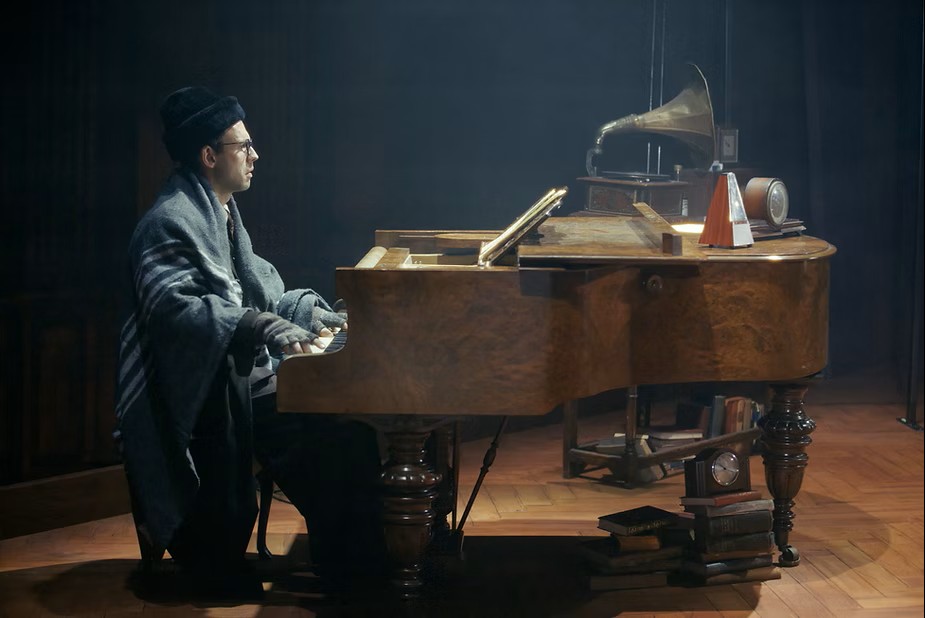
Rosalind Adler and Lea Sellers’ play follows Dmitri Shostakovich through Stalin’s Russia, asking what it means to create music when survival requires you to obey, compromise and become part of the regime you live under. – ★★★★☆
Rosalind Adler and Lea Sellers’ new play about Dmitri Shostakovich tells the story of a composer trying to keep making music while living under a regime that can turn an artist from a national hero into an enemy almost overnight. It is an ambitious subject, and the production at Park Theatre has strong performances, good use of sound and projection, and a lot of energy. Its questions about artistic freedom and compromise feel particularly timely. At times, though, it moves so quickly through Shostakovich’s extraordinary life that some of the most important moments feel rushed.
Shostakovich first appears out of complete darkness, caught in a spotlight. He is lanky, nervous and instantly recognisable in his round glasses. It is 1936 and he has just had a huge success with Lady Macbeth of Mtsensk. His wife Nina is heavily pregnant and admirers gather around him. History tells us that Stalin walked out of the opera, and shortly afterwards Pravda published its notorious attack on the composer, calling the work “Muddle Instead of Music”.

The change in Shostakovich’s fortunes is frighteningly quick. A successful young composer suddenly has reason to fear for his career and his life. That tension gives the first act much of its energy and makes him a difficult and interesting figure for a play. Holy Fool does not attempt to decide whether he was a hero, a coward or a tortured genius. He has a family to support and music to write, and learns how to survive by saying what is expected of him in public while trying to preserve something of himself in his work. In the second act, after Stalin’s death, the play becomes more concerned with the consequences of Shostakovich’s compromises, his health, his relationships and the music he has kept hidden.
Benjamin O’Mahony gives Shostakovich a restless energy from the beginning. There is always something slightly nervous about his Mitya, as Shostakovich was known to his inner circle, even in moments of success, as though he knows that the ground beneath him can shift at any time. As he gets older and his health deteriorates, O’Mahony changes his physicality through acting rather than relying only on elaborate ageing make-up.
Jenna Augen is particularly good as Nina. She is intelligent, dry and often very funny, and her relationship with her husband feels lived-in rather than simply functional to the plot. Nina punctures some of the solemnity surrounding Shostakovich, and Augen gives her an emotional seriousness.
Phoebe Pryce plays Katya, a young aspiring musician fascinated by Shostakovich and his music. Charmed by her youth and enthusiasm, he encourages her to pursue a musical career.
When she returns much later in the play, she is a plumber, having followed her father into the trade. The contrast gives Shostakovich an opportunity to see his compromises from someone else’s point of view. Pryce gives these scenes plenty of bite. The relationship, though, has been developed so late that there isn’t quite enough emotional history between them for the confrontation to have the impact it might.
Fergus O’Donnell plays Izaak, Shostakovich’s friend, as well as several other roles. He is a versatile presence, with a good comic instinct, moving easily between Shostakovich’s inner circle and the wider world around him. His plumber, in particular, brings a welcome touch of absurdity to the production.

In Holy Fool, scenes change rapidly, dates and locations appear on the backdrop, and the story is told in a largely linear fashion rather than through complicated flashbacks. Voices of journalists, critics and officials come through the speakers, sometimes surrounding Shostakovich when he is questioned or criticised. It creates the sense of a much larger political world pressing in on the four actors. The lighting follows the shifts in the story: Shostakovich is isolated in a spotlight at the beginning, domestic scenes are more intimate, and the space becomes brighter when he is abroad.
It helps to know something about Shostakovich’s biography and his major works before seeing the play, because otherwise the significance of the Fourth Symphony, the Fifth or the Seventh can be difficult to grasp. The siege of Leningrad, an extraordinary period in both Shostakovich’s life and Soviet history, and the death of Nina, a deeply personal loss, are both dealt with briefly before the story moves on.
Still, it is difficult to know how else you would tell this story without making very different choices. Shostakovich lived through Stalin’s purges, the Second World War, official condemnation and rehabilitation, international fame and decades of political pressure. There is simply too much life here.
You could draw contemporary parallels. A production about an artist trying to preserve freedom of expression while living under political pressure inevitably speaks to the present, wherever artists, writers or journalists are still expected to watch what they say. There is also a quieter warning in Shostakovich’s story: once freedom of thought and expression has been restricted, finding your voice again can be much harder than it was to lose it.
Holy Fool
Park Theatre, Finsbury Park
Until 10 October
Running time: 2 hours 20 minutes, including an interval
Tickets: https://parktheatre.co.uk/events/holy-fool/

Elena Leo is the Culture & Lifestyle Editor of Ikon London Magazine.


