
Pink Rabbit Review: The Many Lives of a Good Muslim Daughter at Soho Theatre – ★★★★★

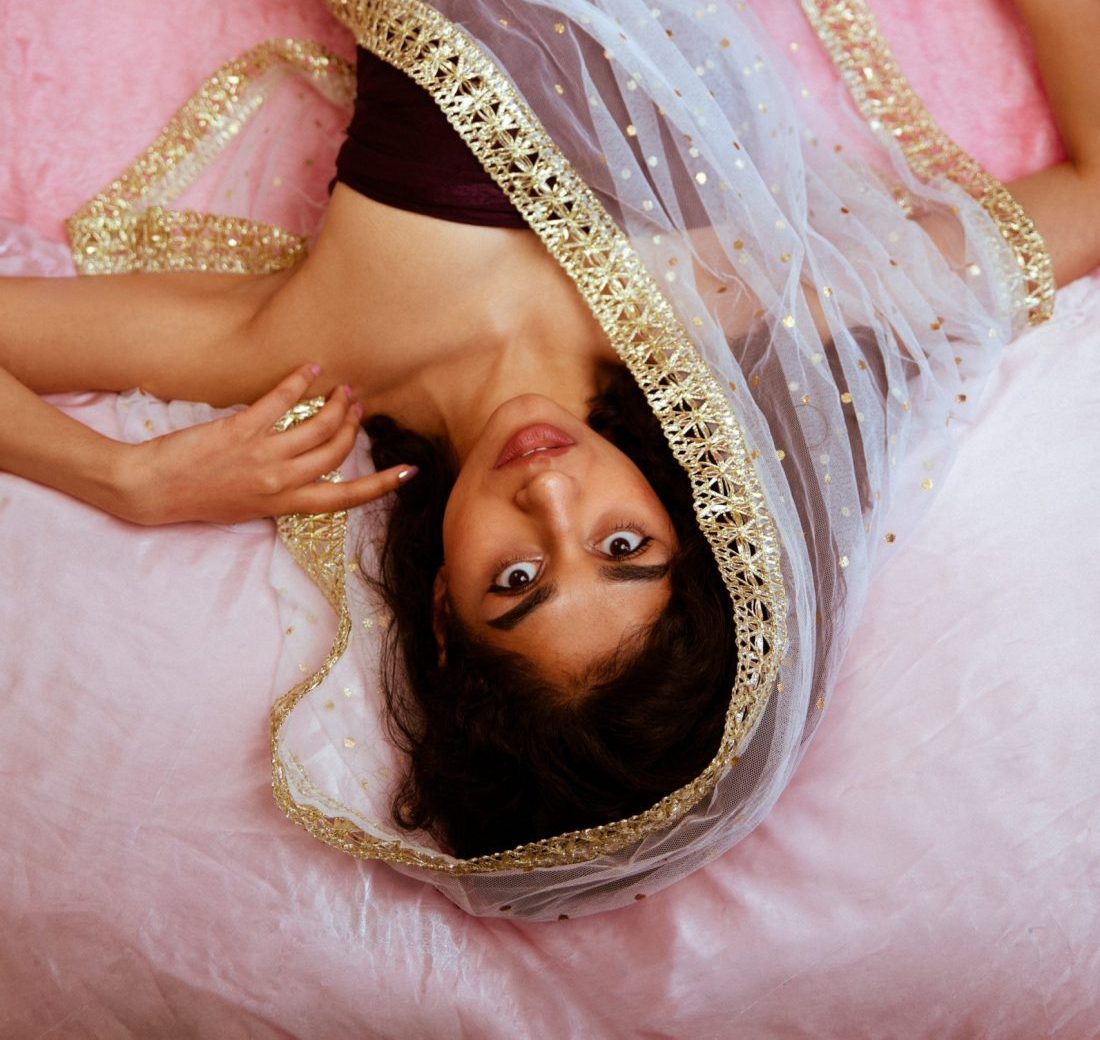
In Pink Rabbit, Farah Ashraf explores the peculiar business of discovering your own sexuality while catering to somebody else’s sexual fantasies. Her cheeky, candid one-woman show is full of astute observations on faith, female desire and growing up in a South Asian Muslim household.
Things are going to get a little haram, Farah Ashraf warns us at the beginning of Pink Rabbit. But don’t tell anybody. She proceeds to brandish a pink vibrator like a gun, pointing it at members of the audience.
Well, we have been warned.
Written and performed by Ashraf, Pink Rabbit comes to Soho Theatre following an acclaimed run at the Edinburgh Fringe.
Meet Amna, a South London sixth-form student who has just turned 18. She prays to Allah, goes to the mosque with her mother, whom she calls ammi (Urdu for mum), and delights her by wearing the hijab. She also attends a biology study group with the girls. The latter, incidentally, is an ingenious cover story for going to her first party.

Her school crush, Zane, sends her sexually explicit videos in the privacy of her DMs but, come the party, proceeds to kiss another girl. Meanwhile, a gentleman with a BMW for a profile picture is willing to part with £50 for a quick phone call.
And so we meet PersianBaby, Amna’s online alter ego, complete with a put-on exotic accent.
As Amna observes, Muslim women in the popular imagination seem to be either terrorists or Mia Khalifa. Having discovered that her ethnicity is a fetish for some men, she sets about making herself even more exotic. Being called a real-life Princess Jasmine is quite flattering. Curiously, in order to explore her own sexuality, Amna invents a woman who caters to somebody else’s sexual fantasies.
Ashraf has a good deal of fun with the religious convictions of Amna’s paying customers. There is, apparently, room for theological debate as to how halal an OnlyFans encounter can be during Ramadan. Amna herself wonders why she should be denying her sexuality when her part of the world gave us the Kama Sutra. At one point, she prays alongside one of her clients and finds the experience more intimate than what preceded it.
Ashraf writes teenage frustration exceptionally well. Amna has acknowledged her sexuality, which is something of an achievement in itself, but is still a long way from feeling comfortable with it. There are things she can do as PersianBaby that she struggles with as Amna.

There is a great deal of affection in the way Amna speaks of home, the smell of her mother’s cooking and her ammi wanting to watch films with her.
For all Amna’s teenage determination not to become her mother, the irony is that her mother doesn’t want her to end up like her either. Having come to Britain and found herself raising a child alone, she wants her daughter to become a lawyer or a “lady doctor” so that she never has to depend on a man.
Ashraf has an extraordinary ability to change the very shape of her face. One moment you are looking at an older Pakistani woman, the next at a young man. Her voice drops considerably when she plays the men, while Amna’s mother speaks with a lovely softness. Of all the characters Ashraf plays, it is perhaps most fascinating to watch her perform a dialogue between mother and daughter. Two women inhabit one body.
There is plenty of uninhibited physical theatre in Alessandro Babalola’s production. Ashraf dances with abandon and, quite early on, takes off her skirt and then her tights. Within the first five minutes, she brings you all in — because she goes all in herself.

I am generally not a fan of audience participation, but Ashraf is a gracious performer and makes remarkably good company. She asks us questions and occasionally looks to us for reassurance. You become the reader of her diary: graphic at times, poetic at others, with all the embarrassing chapters preserved.
Lolly Whitney Low’s set consists of little more than a pouffe upholstered in traditional South Asian fabric, a few pieces of similarly patterned carpet and two microphones. Much of the scenery comes courtesy of sound designers Babalola and Naomi Shanson. A tap running and we are in a bathroom; birdsong and we are in a village in Pakistan. Shanson’s lighting gives the production an almost cinematic quality. It is quite something to travel between a village in Pakistan and South London, visit a school, a party and a restaurant without ever taking your eyes off one actress in a little black box.
It takes some nerve to get on a London stage and wave a sex toy about while playing a young Muslim woman. What I like about Ashraf’s writing is that she feels under no obligation to make Amna an exemplary one. The girl can be quite infuriating, and there are moments when you find yourself sympathising more with her mother. Neither is a saint nor a committed sinner; both are women with convictions, trying to figure life out.
Pink Rabbit
Soho Theatre
21 Dean Street, London W1D 3NE
24 November – 12 December 2026
Running time: 70 minutes.
Age guidance: 16+.
Tickets from £22.
Website: https://sohotheatre.com/events/pink-rabbit/

Elena Leo is the Culture & Lifestyle Editor of Ikon London Magazine.


