
Romeo and Juliet review at Greenwich Theatre: An ambitious launch that never finds its dramatic footing

Greenwich Theatre Productions launches its first Shakespeare production with a music-led Romeo and Juliet featuring a six-strong cast of actor-musicians and a female Romeo. The ambition is clear, but the production’s many ideas rarely cohere into a convincing theatrical world.
Launching a Shakespeare strand is a significant moment for any producing theatre, particularly one hoping to establish a lasting tradition. Greenwich Theatre Productions opens that chapter with a music-infused Romeo and Juliet, directed by artistic director James Haddrell, whose central intervention is to cast Romeo as a woman. It is an idea worth exploring. So are the production’s other choices: a six-person ensemble doubling roles, live folk-inspired music performed by the cast, and a stripped-back visual aesthetic. Yet these ideas never settle into a production with a clear dramatic identity.
Haddrell argues in the programme that making Romeo female shifts the focus away from gender and sexuality towards the universality of young love. In performance, however, the production never establishes the rules of the world it has created. Romeo, played by Blossom Timothy, is referred to with altered pronouns yet dressed conventionally as a young man. Female actors also play Mercutio and Friar Lawrence, while Lord Capulet and Lord Montague remain unmistakably patriarchal figures. The production hints at a more fluid social order without ever defining it, leaving the audience trying to decode the concept rather than follow the story.

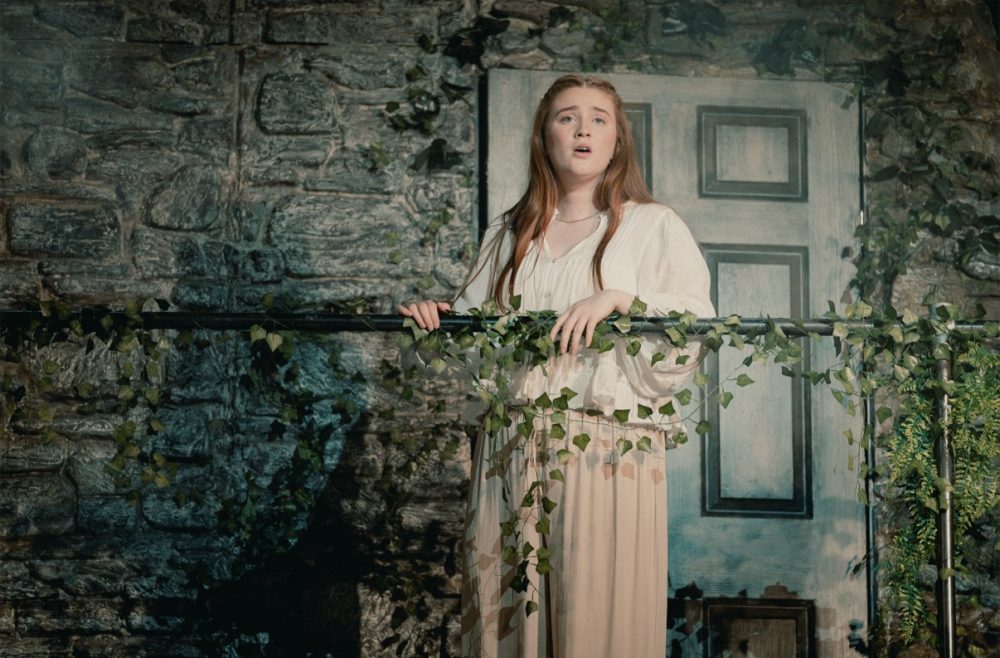
The design presents a similar problem. A single wall dressed with sparse artificial climbing plants serves as the principal setting throughout. Minimalism can sharpen attention on language and performance, but here the stage remains stubbornly anonymous. It is neither recognisably Verona nor convincingly relocated elsewhere. Costumes do little to distinguish character, hierarchy or period. Lady Capulet’s dress repeatedly reappears beneath Friar Lawrence’s robes during quick changes, and scenes are left with too little visual definition to establish where, or even when, they are taking place.
The cast are asked to do an enormous amount. Six actors cover Shakespeare’s large cast while also providing the live accompaniment, moving confidently between guitars, percussion, flute, harmonica and other instruments. Their musicianship is one of the production’s genuine strengths and several vocal performances are accomplished. The songs themselves are less persuasive. Just as scenes begin to gather emotional weight, the action repeatedly gives way to another musical interlude. Even the play’s closing moments are followed by a full-cast song, blunting rather than deepening the impact of Shakespeare’s final lines.
The same unevenness runs through the performances. Constant doubling demands sharply defined characterisation, yet several role changes blur together, making it surprisingly difficult to follow who is who. Projection is another persistent problem. Greenwich Theatre is intimate, but it still requires actors to send Shakespeare’s language to the back of the house. Too many lines disappear into the heat-heavy air, softening both the wit and the emotional stakes. Matt Penson brings conviction to Lord Capulet’s volatile shifts between paternal affection and explosive anger, while Nikita Johal finds more definition in Mercutio than some of the evening’s other doubled roles. Ava Honey’s professional debut as Juliet shows commitment throughout, despite spending much of one of London’s hottest evenings wrapped in heavy costume and bedding.

There are glimpses of a stronger production. Kaitlin Howard’s fight direction is taut, fluid and genuinely exciting, lending urgency to confrontations that elsewhere struggle to ignite. The sword fights have clarity and pace that much of the surrounding drama lacks. No one appears short of effort. The performers often seem to be pushing harder than the production around them.
The heat deserves a mention, if only because it became another presence in the room. Audience members armed themselves with programmes and handheld fans while the cast pressed on through two and a half demanding hours. Even allowing for the temperature, the evening rarely gathers the pace on which Romeo and Juliet depends. Scenes that should tumble breathlessly into the next instead pause for another song or an uncertain transition, and the tragedy steadily loses its urgency.
Greenwich Theatre has every reason to pursue a resident Shakespeare tradition. Few London theatres are as well placed to serve such a varied audience, drawing theatre-goers from Greenwich and Blackheath alongside communities in Deptford, Lewisham and the rapidly growing Peninsula. The capital’s strongest producing theatres often grow from a clear sense of place, whether at Arcola Theatre or Theatre Royal Stratford East, and Greenwich has the opportunity to develop its own identity rather than imitate anyone else’s. A confident, distinctive Shakespeare programme could become a real asset for south-east London. This inaugural production suggests the ambition is there. What remains is to develop an artistic identity capable of sustaining it.
Romeo & Juliet
Greenwich Theatre, Crooms Hill, London SE10 8ES
3–25 July 2026
Tickets: https://greenwichtheatre.org.uk/events/romeo-juliet/

Elena Leo is the Culture & Lifestyle Editor of Ikon London Magazine.


