
The Constant Wife review — a century-old comedy with sharp new teeth

★★★★☆ Laura Wade reshapes Somerset Maugham’s 1926 comedy into an elegant , unsentimental study of marriage, money and leverage, anchored by Kara Tointon.
At first glance, The Constant Wife looks like a polished period revival: pastel art deco interiors, cocktails on a trolley, a grand piano waiting to be played. But Laura Wade’s adaptation, directed by Tamara Harvey for the Royal Shakespeare Company and now touring the UK through Richmond, is less interested in nostalgia than in leverage — specifically, who has it inside a marriage, and how it can be reclaimed.
The premise could sit comfortably in an agony aunt column. What does a financially dependent wife do when she knows her husband is having an affair with her best friend — and knows that divorce would leave her “in two rooms above a florist”? What should her mother advise? What should her sister say? And what happens when the wife decides the betrayal is nobody’s business but her own?
Maugham’s 1926 original concerned a woman who declines to behave as expected. Wade keeps the skeleton but shifts the muscle. The revelation arrives early; the tension lies not in whether Constance knows, but in what she intends to do with that knowledge. It becomes a play about strategy rather than scandal — and about the theatre of domestic composure.
Constance Middleton (Kara Tointon) appears to have everything required for happiness: a respected Harley Street surgeon husband, a well-appointed home, a daughter newly dispatched to boarding school. “Nonsense,” insists her mother when told she might be unhappy. “She eats well, sleeps well, dresses well and she’s losing weight.” A century on, the line still stings.

Tointon anchors the production with calm authority. Her Constance is observant and often lightly amused. She listens more than she reacts. Moments of sadness — particularly when speaking of her daughter — are brief and contained. The power of the performance lies in the restraint of a woman who refuses melodrama because she is already planning the next move.
Amy Vicary-Smith’s Martha, Constance’s unmarried sister and business partner, injects a lot of energy into the production. Entrepreneurial and unsentimental, she is the most openly modern presence on stage. Her rapid-fire recap at the start of Act Two — a breathless summary of the previous chaos — is both technically deft and genuinely funny, earning audible appreciation from the audience.
Sara Crowe’s Mrs Culver represents the older order: endure, don’t disturb, preserve appearances. The performance occasionally veers toward caricature, but Chrowe still lands the sharper lines with dry conviction. Once she reveals that Constance’s father was also unfaithful, both the character and performance soften. By the end, she stands as her daughter’s quiet ally.
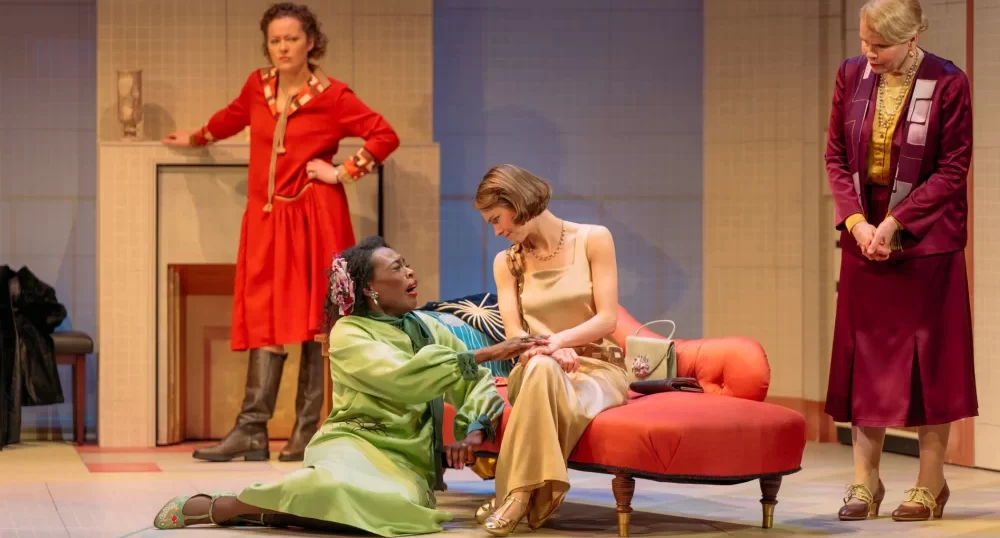
Gloria Onitiri’s Marie-Louise — the cheating best friend — leans into theatricality: collapsing onto furniture, lamenting her exposure, accusing Constance of cruelty for having known all along. The exaggeration sharpens the satire of male infidelity treated as trivial inevitability.

The men are drawn thinner, but effectively so. Tim Delap’s John Middleton begins with the ease of a man certain he will be forgiven — urbane, faintly smug, professionally self-assured. As Constance shifts the ground, Delap lets that composure fray. Jules Brown, stepping in as Bernard on this performance (with Alex Mugnaioni absent), plays Constance’s long-devoted admirer as earnest and slightly stiff — less romantic hero than useful counterweight. Recently returned from Kobe, where he has built a successful business and preserved his devotion to Constance, he offers something concrete: a viable alternative life. When Constance announces she will travel abroad with him “as man and wife” — though in fact she intends to go alone — the fiction provides a dramatic triangulation that forces John Middleton to reassess the balance of their marriage.
Philip Rham’s Bentley the butler provides a textured counterpoint. In discreet exchanges over whisky and shared confidences, he and Constance step briefly outside the rigid lines of class. The clearest truths in this house are spoken away from its official hierarchies.

Wade’s structural interventions are subtle but decisive. She shifts the key revelation forward — Constance already knows about the affair — and what follows is a carefully managed set of flashbacks. Events appear less like scandal and more like evidence being assembled: the wife building a strategy. There is even a neat meta touch: Constance and Bernard attempt to go and see a play titled The Constant Wife, but never make it — her own domestic drama keeps her far too busy.
Visually, the production is disciplined. Anna Fleischle’s art deco interior — faded salmon pink, aquamarine green, angular lines framing a drinks cabinet and piano — remains largely unchanged across two acts. Cat Fuller and Fleischle’s costumes look as though they were taken from a fashion magazine of the time rather than a 1920s-themed costume party: geometric prints, handkerchief hems, sharply cut day dresses and suits, elegant evening ensembles.
Jamie Cullum’s music is used sparingly. A few jazz-inflected piano passages, lightly threaded through scene changes, keep the mood buoyant and add polish to the production.
What ultimately sharpens the play is not the affair itself but Constance’s response to it. She refuses public humiliation and refuses theatrical revenge. Instead she insists on economic independence, emotional recalibration and — most cuttingly — symmetry. Near the end, Constance offers her husband a parting observation: during her six-week absence he may discover that forgiveness is sweeter than revenge. It sounds conciliatory, but it isn’t. It is a negotiation, and she is the one setting the terms.
The Constant Wife feels less like a period curiosity than a quietly unsentimental study of how power actually works.
Photos by Mihaela Bodlovic
The Constant Wife
Richmond Theatre
The Green, Richmond, Surrey TW9 1QJ
Runs: 9–14 February 2026
Following Richmond, the UK tour continues until 16 May 2026, concluding at Theatre Royal Bath (11–16 May 2026).
The production then transfers to sea for performances aboard Queen Mary 2 during a Cunard Transatlantic Crossing.
Tour venues include: Blackpool, Chichester, York, Oxford, Brighton, Chelmsford, Liverpool, Salford (The Lowry), Cambridge, Edinburgh, Shrewsbury, Leeds, Cheltenham, Poole, Malvern and Bath.

Elena Leo is the Culture & Lifestyle Editor of Ikon London Magazine.


