
Pillion: Harry Lighton’s Bold Debut Brings BDSM Romance to Cannes

A tender exploration of power dynamics earns seven-minute standing ovation at Un Certain Regard
When Eva Yates at BBC Film sent first-time director Harry Lighton the novella “Box Hill” by Adam Mars-Jones, his initial reaction was telling: “I thought it sort of maybe said something about Eva’s idea of me that she sent me the filthiest book I’d ever read.” But beneath the provocative surface of this BDSM romance, Lighton found something deeper – a story about power, vulnerability, and the search for connection that would become his striking directorial debut, “Pillion.”
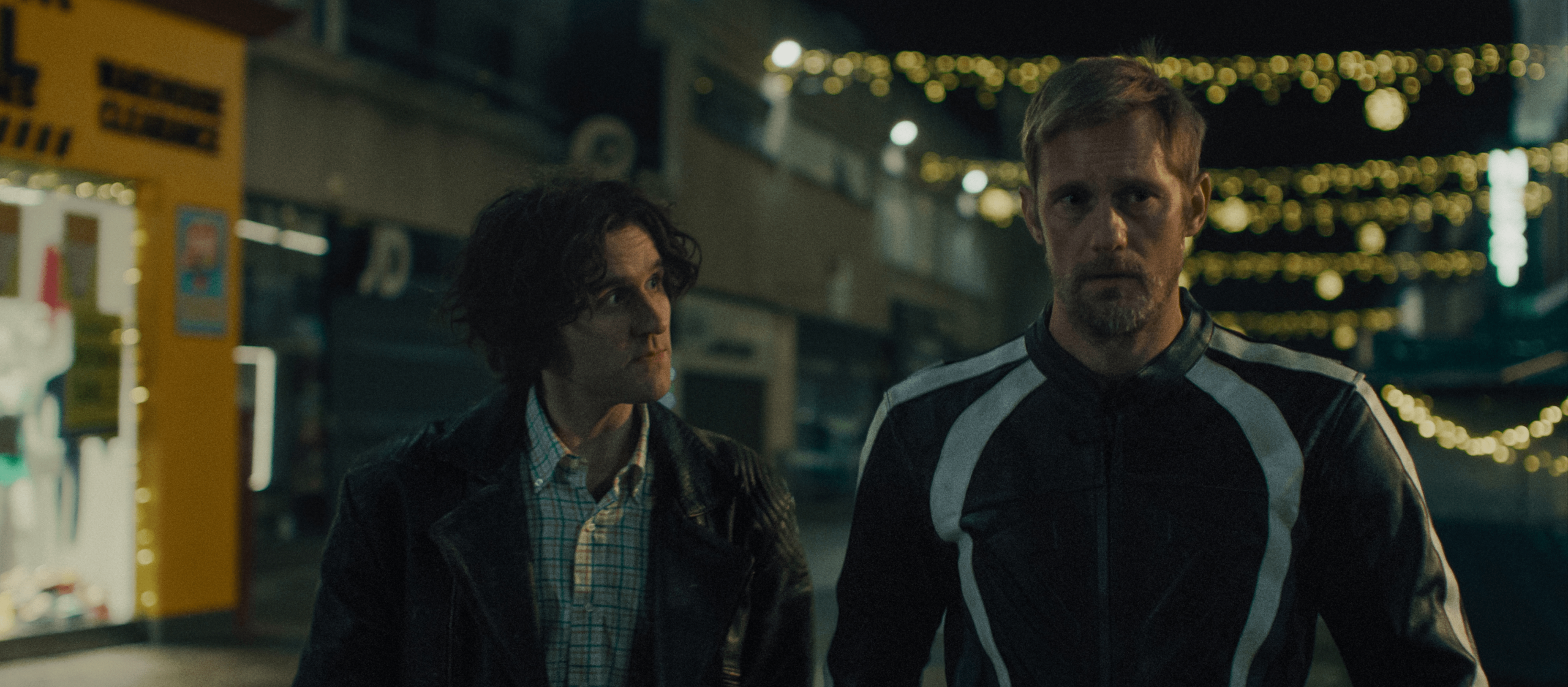
The film, which premiered at the 2025 Cannes Film Festival in Un Certain Regard on May 18 and earned a seven-minute standing ovation, follows Colin (Harry Melling), a suburban “social romantic professional loser” who becomes involved with Ray (Alexander Skarsgård), an enigmatic biker who introduces him to the world of BDSM. But far from exploitation, Lighton has crafted something unexpectedly warm and humorous – a film that finds “the balance between brutality and tenderness.”


Transforming the Source Material
Adapting Mars-Jones’s 1970s-set novel, Lighton made significant changes to serve his vision. Most notably, he updated the setting to contemporary times, removing what he saw as “obvious explanations for maybe why a gay guy might hide his identity in the ’70s.” By placing the story in the present day, Lighton could explore how “withholding information was part of a power dynamic, rather than a reaction to social oppression.”
The filmmaker also enhanced the novel’s comedic elements while maintaining its emotional complexity. “The book is funny, certainly, but I think the sexual dynamic is harsher in the novel and kind of more unbending,” Lighton explained during the film’s post-screening discussion at the British Pavilion. “I knew that I wanted to try to find the balance between brutality and tenderness in the relationship, which perhaps was less present in the book.”

Casting Chemistry and Contradictions
The casting of Harry Melling as Colin proved inspired, with Lighton recognizing the actor’s unique screen presence after seeing him in “The Devil All the Time.” “He has this incredible charisma, which feels genuinely unique in that he’s not like an alpha male,” Lighton observed. “He’s often playing quite peripheral, sort of set-upon characters, but he’s like a kind of screen magnet in a way… He demands the attention of the audience even when he’s being very passive.”
For the role of Ray, Alexander Skarsgård brought his own compelling contradictions. “He has all the trappings of the world’s biggest alpha male of all time. And yet he’s mischievous and playful,” Lighton noted. “You needed Ray to not just be a hunk. You needed them to know that whatever was lurking under the surface was interesting.”
Remarkably, neither actor delved into extensive backstory discussions. “I never wanted to know for sure what Ray’s backstory is,” Lighton revealed. “The interest is in wondering whether Ray’s the product of a trauma response or he’s the product of someone who’s just built his life around being the world’s best dom.”
Progressive Family Dynamics
One of the film’s most striking elements is Colin’s relationship with his supportive parents, played by Lesley Sharp and Douglas Hodge. Unlike typical LGBTQ+ narratives focused on familial rejection, Colin’s parents are “extremely permissive” and actively encourage his dating life.
“I’m a little tired of the same sort of tropes of homophobic parents,” Lighton explained. “I thought a more interesting question was: at what point do incredibly liberal-minded parents say, ‘Actually, no, this isn’t right for my son?’ And is that based on legitimate concern for the son’s wellbeing or is it based on them superimposing their relationship model onto their son?”
This approach reflects Lighton’s broader philosophy about depicting BDSM culture: “If you speak to anyone in the kink community, the kink aspects of their lives often exist alongside very mundane lives. They’re still taking their dad’s dog for a walk. They’re still at Christmas dinner.”
Authentic Community Collaboration
The production’s commitment to authenticity extended to working with the GBMCC (the UK’s biggest gay motor biking club), whose members appeared in the film and provided technical expertise. “I didn’t want anyone from that community to look at those scenes and be like, ‘You got this wrong,'” Lighton emphasised.
This attention to detail proved invaluable both narratively and practically. As producer Lee Groombridge noted, “They came with their bikes. If you were hiring motorbikes, picture vehicles are expensive, so they were great for us.” The collaboration also provided crucial specificity to both the sexual and motorcycling scenes, lending credibility that could have easily felt performative in less careful hands.
Technical Innovation on a Budget
Working with a modest £2-3 million budget over 20 shooting days, the production team employed creative solutions to achieve their ambitious vision. Cinematographer Nick Morris utilised unconventional equipment, including the DJI Ronin 4D (recently popularised by “Adolescence”) for tracking shots and a Red Komodo for rigging sequences.
“The intention, the dream was to lay 300 feet of track and track alongside them forever,” Morris explained about the motorcycle sequences. “Everyone was like, ‘That’s not gonna happen.’ So we used these couple of little toys effectively, that meant we could work in a quicker and more fluid way.”
The film’s most complex sequence – an outdoor group scene shot during golden hour – required extensive choreography and planning. “We managed to shoot this incredible [scene] which is one of the things I’m most proud of with moving camera,” Morris noted, crediting intimacy coordinator Robbie Taylor with creating “a space where you can do something that’s expansive and have something that’s safe and intimate at the same time.”
Editorial Alchemy
Editor Gareth C. Scales worked closely with Lighton throughout production, cutting scenes daily and maintaining ongoing dialogue about the film’s tonal balance. One key discovery emerged in the editing room regarding Harry Melling’s performance: “Harry Melling had all these little noises, like ‘ooh’ and ‘yeah,’ and we kind of mined the footage for those moments, and it just made it that much funnier.”
The editing process also revealed crucial character moments, particularly with Skarsgård’s intentionally detached performance. “What we found as the shield starts to be worn down… there’s moments where he starts to become a little bit more human,” Scales observed. “We found those lovely little looks that he gives every once in a while that just shows that there’s something behind the facade.”
Perhaps most significantly, the filmmakers discovered the importance of a key dinner scene featuring Colin’s parents, which went through numerous iterations. Originally scripted with the mother having a coughing fit that drives Ray away, the final version instead has her directly confronting Ray about his relationship with Colin – a change that “completely changes the dynamic of everything.”
A New Voice in British Cinema
“Pillion” represents a significant achievement for British independent cinema, tackling subject matter that could easily have felt exploitative or sensationalized. Instead, Lighton has crafted something genuinely surprising: a film that treats its BDSM themes with matter-of-fact honesty while finding humor and humanity in unconventional relationships.
The film’s Cannes reception suggests audiences are ready for LGBTQ+ stories that move beyond trauma narratives toward more complex explorations of desire and connection. With A24 handling U.S. distribution and Picturehouse Entertainment releasing in the UK, “Pillion” is positioned to reach audiences hungry for authentic, uncompromising queer cinema.
For Lighton, who spent seven years away from directing before this project, the experience proved transformative. “The biggest surprise was generally that I enjoyed it,” he reflected. “I really loved the shoot and it made me remember I liked directing.”
As “Pillion” prepares for its wider release, it stands as a testament to the power of authentic storytelling, collaborative filmmaking, and the courage to find tenderness in unexpected places. In an era where authentic queer representation remains vital, Lighton’s debut offers something rare: a love story that’s unafraid to explore the full spectrum of human connection, however unconventional it might appear.

Editor in Chief of Ikon London Magazine, journalist, film producer and founder of The DAFTA Film Awards (The DAFTAs).


