
René Magritte’s strange afterlife arrives in London with a major Gagosian exhibition

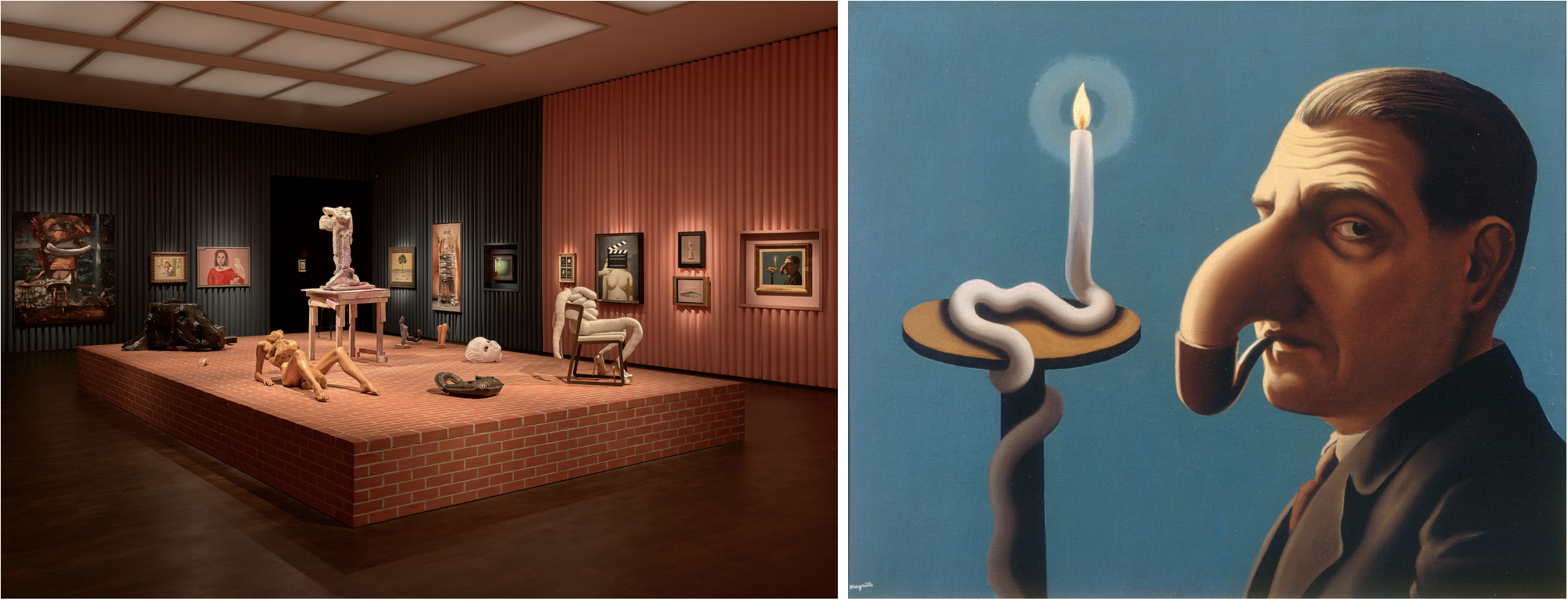
Gagosian’s new London exhibition brings together major works by René Magritte with more than 40 contemporary artists, from Jeff Koons and Mona Hatoum to Dana Schutz and Anna Weyant.
René Magritte has been dead for nearly six decades, but his ideas are everywhere. The bowler hats, floating apples, impossible skies and, of course, the pipe that emphatically isn’t a pipe have long since escaped the art gallery and made their way into advertising, fashion, design and popular culture. Now a new exhibition in London asks what happened after Magritte.
This Is Still Not a Pipe: The Afterlife of Magritte, opening at Gagosian’s Grosvenor Hill gallery to coincide with Frieze London, brings together works by Magritte from across his career with more than 40 artists who have responded to his peculiar mixture of wit, mystery and visual mischief.

The exhibition, organised with the Fondation Magritte, includes loans from museums and private collections alongside works by living artists, many made specifically for the show. Magritte’s familiar cast of apples, pipes, bowler hats and cotton-cloud skies is therefore placed in rather different company, alongside artists including Jeff Koons, Mona Hatoum, George Condo, Sarah Lucas, Yoko Ono, Ed Ruscha, Charles Ray, Dana Schutz, Jordan Wolfson and Anna Weyant.
There is plenty of Magritte to begin with. The earliest painting in the exhibition is Les Fleurs du voyage (The Flowers of the Journey) from 1926, made shortly before his move to Paris and shown in his first solo exhibition in Brussels the following year. Other highlights include La Clef des songes (The Interpretation of Dreams, 1935), La Lampe philosophique (The Philosopher’s Lamp, 1936), La Trahison des images. Ceci continue de ne pas être une pipe (The Treachery of Images. This Is Still Not a Pipe, 1952) and L’Empire des lumières (The Dominion of Light, 1961).

The latter is particularly apt for an exhibition concerned with Magritte’s afterlife. One of his most famous tricks was to make familiar things suddenly behave incorrectly: daylight and darkness occupy the same sky; an object refuses to be the thing its label says it is; an ordinary room becomes faintly sinister. The joke is usually simple. The implications are not.
The contemporary works suggest how far that way of thinking has travelled. Historical pieces by Vija Celmins, Ono, Ruscha and Betye Saar show Magritte’s influence during his own lifetime, while newer works by artists including Harold Ancart, Allison Katz, Jill Mulleady, Dana Schutz, Pol Taburet and Anna Weyant bring the conversation into the present. Several are being shown publicly for the first time.
The result is less a conventional survey of influence than an argument that Magritte’s particular brand of visual sabotage remains remarkably useful. He made pictures that looked straightforward until they weren’t. Contemporary art, it seems, has not quite finished with the trick.
This Is Still Not a Pipe: The Afterlife of Magritte is curated by Jasper Sharp and Bernard Lagrange, in collaboration with Charly Herscovici and the Fondation Magritte.
THIS IS STILL NOT A PIPE: THE AFTERLIFE OF MAGRITTE
24 September – 12 December 2026
20 Grosvenor Hill, London
Featured image: This Is Still Not a Pipe: The Afterlife of Magritte, installation view, 2026, Artwork © Dana Schutz; © 2026 ADAGP, Paris and DACS; © Jill Mulleady; © Talia Chetrit; © Anna Weyant; © Alex Da Corte; © Isabelle Albuquerque; © Rachel Harrison; © Mona Hatoum; © Nairy Baghramian; © Jordan Wolfson; © Jeff Koons; © Sarah Lucas
Photo: Prudence Cuming Associates Ltd Courtesy Gagosian; René Magritte, La Lampe philosophique (The Philosopher’s Lamp), 1936, Oil on canvas, 50 x 66cm, © 2026 C. Herscovici/Artists Rights Society (ARS), New York Courtesy Private Collection, Brussels, Kingdom of Belgium

Elena Leo is the Culture & Lifestyle Editor of Ikon London Magazine.


