
Present Laughter at Richmond Theatre — Laughter, Eventually -★★★★☆

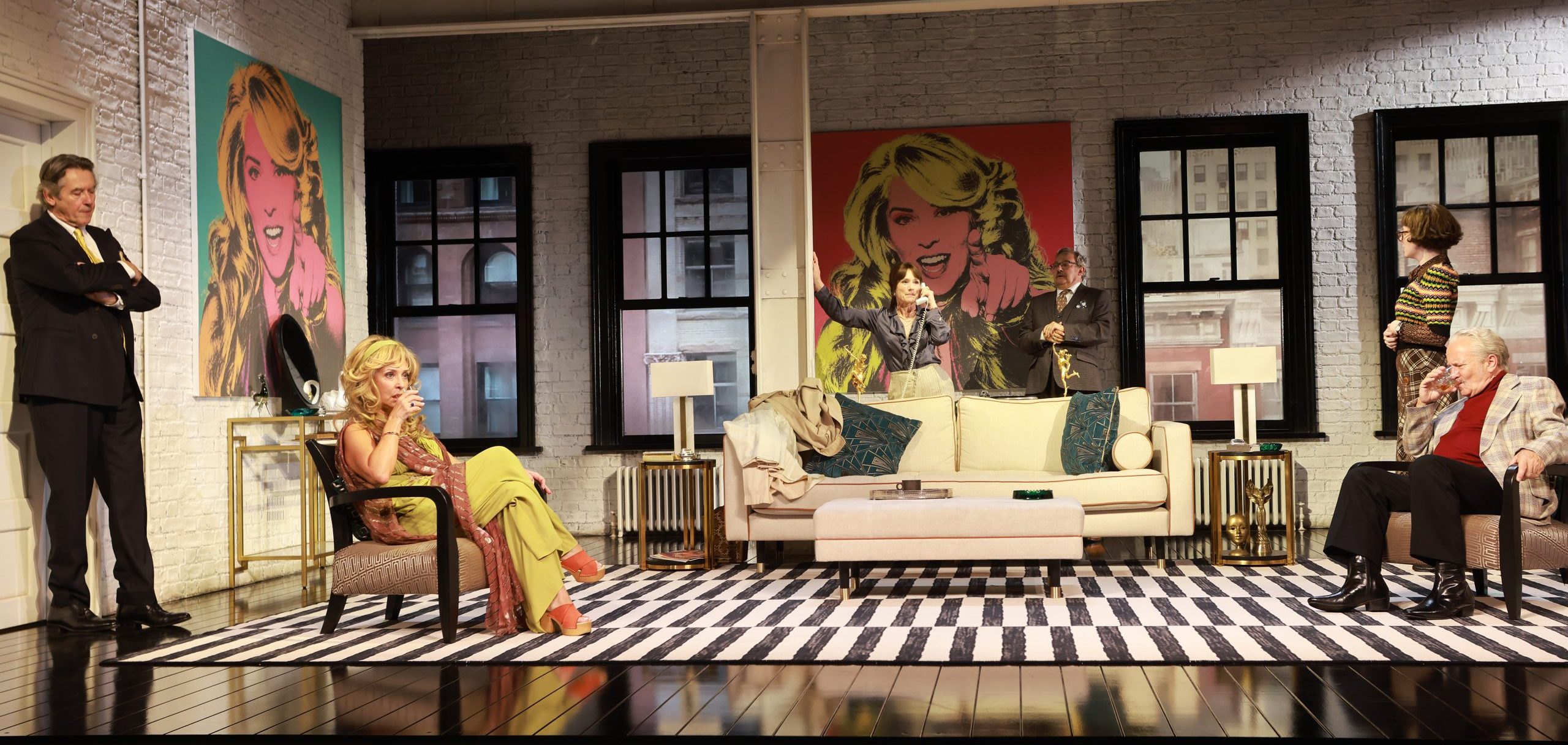
Tracy-Ann Oberman turns Coward’s famous male star into a woman with an appetite of her own. The first act takes patience; by the second, the patience is rewarded.
What happens when a small household revolves around the whims, appetites and indiscretions of an ageing star? In Noël Coward’s Present Laughter, quite a lot — eventually. Lindsay Posner’s production, starring Tracy-Ann Oberman as Geri Essendine, takes a surprisingly long time to get going. The first act is a lot of declamation, eye-rolling and people explaining themselves while the comedy waits patiently in the wings. But it becomes very funny when Act II comes, everybody arrives at once, everybody has something to hide and everybody is liable to walk through the wrong door.
Coward wrote Present Laughter in 1939 as a star vehicle for himself, playing Garry Essendine when the play opened in Blackpool in 1942. This 2026 production makes a gender switch and Garry becomes Geri. The character remains true to its roots: a familiar Coward creation, famous, pampered, vain, sexually adventurous and surrounded by people who depend on her while pretending not to be impressed.
When Oberman turns Garry into Geri, the gender switches ripple through the household: the secretary Monica is now Monty, the estranged wife Liz becomes Len, the young admirer Daphne is David, the aspiring playwright Roland is Rosina, and Joanna becomes Johannes. If it always works is debatable, but it is a stellar move, because suddenly the sexual freedom, vanity and self-importance traditionally granted to Coward’s male star belong to a woman. Geri wants to want, must have what she wants and seems not quite to understand that wanting has consequences.

Geri is an actress, naturally, but the performance never really stops when she leaves the stage. At home, she is still playing Geri Essendine, and Oberman catches that instinct to act at all times — and at all costs. Almost every interaction has a theatrical edge, as if Geri suspects that even breakfast might receive a review or attract the paparazzi. At times, though, Oberman holds the same pitch for too long: the voice, volume and agitation rarely settle, making it harder to glimpse the vulnerability beneath all that celebrity performance.
The truth is, Geri needs to be needed. She has everything that ought to make a person happy: money, fame, attention, sex, work and an army of people ready to bring breakfast upstairs, cover her lies and indiscretions, and provide a shoulder to cry on. Yet the more people surround the star, the less obvious it becomes who actually knows her, and whether she knows herself.
We meet the public Geri while waiting for the performance to begin: the safety curtain is plastered with imaginary newspaper cuttings chronicling her glamorous existence: parties, celebrities, royals — the New York social whirl, because the action is moved to 1970s America. Her apartment is less a private residence than a waiting room for people hoping to get a piece of the star, not her refuge but a part of her celebrity persona.
Peter McIntosh’s set gives her a suitably fabulous front room: the raw bones of a New York loft — stark white brick, modern lines and a bright red spiral staircase leading towards the bedroom — with echoes of Art Deco glamour, the world of Coward’s era. The Warhol-style portrait of Geri and Studio 54 references make the setting feel thoroughly New York. It makes good use of the stage to suggest a world beyond that room; doors open onto the guest room and office, while the windows suggest a Manhattan that never stops moving. People disappear upstairs, emerge from bedrooms, fetch drinks from the unseen kitchen and often materialise precisely when they shouldn’t. It creates a great machine for farce, and in the second act this machine finally gets put through its paces.
Seb Carrington is excellent as David Stillington, the well-off nephew of Lady Saltburn, who already belongs to high society in his own right but is nevertheless drawn to the flame of fame. The play opens with David emerging from Geri’s guest bedroom, having spent the night there. Carrington seems genuinely smitten, with just the right mixture of innocence and physical comedy. His dancing in the second act is a small triumph of timing and enthusiasm.
The second act’s structure almost mirrors the first: another young man has spent the night, another morning begins, and Geri’s household must spring into action around the latest complication. The difference is that the first person was an outsider, and the second one is a married member of her tightly knit set. So the main conflict and comedy is in who knows what, who has slept with whom, who is pretending not to know, who has arrived at the wrong moment — the choreography and timing create the comic effect.


Richenda Carey is beautifully cast as Lady Saltburn, the aristocratic aunt who brings David to Geri for an audition while remaining suitably awed by the actress herself. She has the posture of someone who has spent a lifetime being taught how to sit in a grand room, and the comic restraint to make the fuss around Geri even funnier.
James Dreyfus’s Monty shows up with authenticity and dry reactions that make us understand that he has seen everything and almost nothing surprises him anymore. There is something wonderfully relatable about a man whose job is to keep the household functioning while everyone else behaves as though it has been struck by a small but glamorous hurricane.
Adrian Lukis is equally good as Len, Geri’s estranged husband. From the way he carries himself, we know he is no admirer; he moves through the apartment with the ease and familiarity of someone who was once part of this daily circus and still knows where everything is. His steadiness makes Geri’s theatricality look even more extreme, but there is warmth in it too. He is still fond of her, understanding of her, perhaps even accepting of her — and there may be a certain convenience in having a celebrity wife without having to deal with all the hassle.
Eva Feiler has the harder task as Rosina Maule, an aspiring young playwright whose interest in Geri becomes considerably more obsessive. Her outfit tells you almost everything before she has finished a sentence: glasses, long socks that keep falling down, an unattractive tight knitted hat and silly granny patterns. If there were a stereotype of the bookworm who turns psycho, Rosina would be it. The character is meant to be absurd, but the performance pushes so far towards silliness and hysteria that her elaborate schemes become difficult to believe. Farce needs people to behave improbably; it still needs us to believe that they might.


Johannes is one of the more successful changes. Joanna’s role becomes a male seducer, producing a knot of relationships: Johannes is married to Henrietta, has an affair with Geri and is also the object of Morris’s affections. Kit Young can feel a little mechanical, but it suits Johannes as a self-surviving man, someone who, like Geri, has learned to get what he wants and keep moving. He is not so different from her after all.
The clothes are terrific across the company. Men appear in high heels; Monty’s three-piece suit makes him look all the more restrained; Len has a sharper, more polished suit. Rosina arrives in her wonderfully peculiar bookworm wardrobe, while Fred, another member of staff, sports an afro and flares alongside his other job as a Studio 54 doorman. Foley gets the more hippie end of the 1970s wardrobe.
Present laughter takes its time. Be patient: when it arrives in Act II, it arrives in full force and becomes what Coward intended: a beautifully dressed mess of vanity, sex and celebrity.
Present Laughter by Noël Coward
Richmond Theatre, The Green, Richmond, Surrey TW9 1QJ
Dates: 22 September – 3 October 2026
Running time: Approximately 2 hours 30 minutes, including an interval
Tickets: official website
All photos by Simon Annand.

Elena Leo is the Culture & Lifestyle Editor of Ikon London Magazine.


