
Review: Stranger Things: The First Shadow at the Phoenix Theatre

★★★★
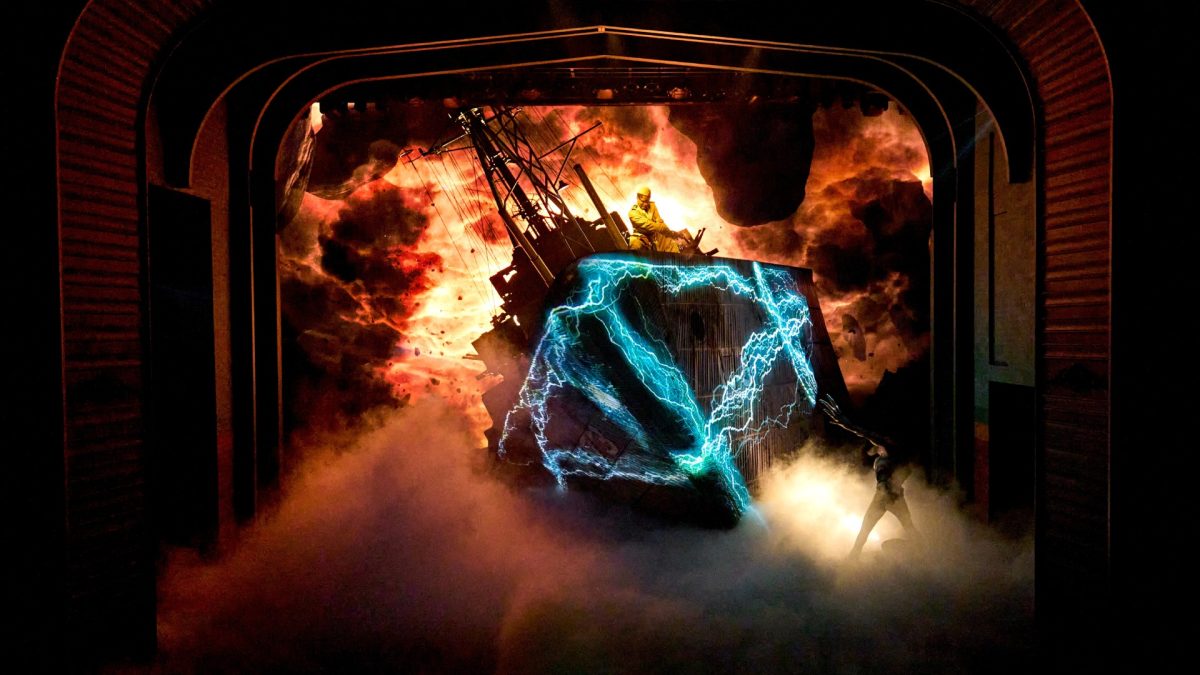
The show dazzles with spectacle, but the narrative struggles to keep pace.
If you’re like me — a fan of the series and a theatre-goer — and have been putting off seeing Stranger Things: The First Shadow, there’s no longer any excuse. I only got around to it just weeks before Season 5, and it proved worth the wait. The show is part fan experience, part dazzling spectacle of light and effects — and a vivid demonstration of what modern theatre can achieve.
Set in 1959 Hawkins, Indiana, the play functions as a prequel, tracing the early life of Henry Creel (Louis McCartney) and the origins of the laboratory that would later shape the horrors of the Upside Down.
The story begins far from Hawkins, with a wartime naval experiment in 1943 that goes disastrously wrong. A ship vanishes, one man survives, and something dangerous is unleashed. Sixteen years later, the fallout reaches small-town Indiana, where a troubled teenage Henry Creel arrives with his family, already struggling to understand what is happening to him. At school, he forms a tentative bond with Patty Newby, whose kindness offers him a rare sense of ease, while elsewhere Dr Brenner begins to observe Henry with growing interest. As everyday teenage life unfolds — classrooms, friendships, a school play — the consequences of that long-ago shipwreck begin to surface, pulling Henry towards the laboratory and the dark future the audience knows awaits him.

The ambition of the show is clear: this is not a modest theatrical spin-off, but an attempt to compress an entire mythology into a single evening. But this ambition comes at a narrative cost. Running close to three hours including an interval, the play races through decades of story with relentless efficiency. Subplots pile up — school corridors, teenage friendships, investigations and experiments — but many are necessarily abbreviated. Several character motivations remain sketched rather than explored. The emphasis is firmly on momentum and incident, not on lingering with emotional consequence.
Miriam Buether’s revolving set allows scenes to slide swiftly from town to laboratory to school, while projections and visual effects by 59 Productions, Jamie Harrison and Chris Fisher are integrated with impressive fluency. Coral Messam’s choreography keeps a densely populated stage moving cleanly, a necessary discipline in a show that rarely slows down. Jon Clark’s lighting spills beyond the stage into the auditorium, creating a sense of immersion unusual in West End theatre, while Paul Arditti’s sound design, supported by Kyle Dixon and Michael Stein’s electronic score, maintains a constant low-level tension beneath the action.

At the centre of this whirlwind, a handful of performances manage to ground the story. Ella Karuna Williams brings heartfelt sincerity and emotional clarity to Patty Newby, effectively becoming the emotional anchor of the piece as Henry Creel’s world begins to fracture. Patrick Vaill’s Dr Brenner is chillingly imposing, his calm authority hinting at the moral coldness that will later define the character.
Supporting performances are worthy of a separate mention. Christopher Buckley brings warmth and quiet charm to Bob Newby, offering moments of genuine human connection amid the spectacle. Max Harwood’s Alan Munson injects energy and lightness, helping vary the show’s rhythm. Oscar Lloyd captures Jim Hopper Jr’s youthful bravado with ease, while Isabella Pappas gives Joyce a spirited determination that avoids simply copying the television version. Together, they strengthen the ensemble, even if their individual storylines sometimes feel more decorative than essential.

That said, the show’s technical command is undeniable. The integration of live performance with illusions, projections and sound is handled with extraordinary confidence. Emotional depth is not always the priority, but audience attention is rarely allowed to drift.
Stranger Things: The First Shadow may sacrifice nuance in favour of speed and scale, but as an immersive theatrical event — particularly for fans of the series — it is difficult to resist.
P.S. A clever extra touch: a free photobooth lets you take home a souvenir image combining this world with the Upside Down — the safest way to prove you’ve been there without risking a demogorgon encounter.
The show runs at the Phoenix Theatre, London.
Duration: 3 hours
Tickets: £20-£185
Buy tickets: strangerthingsonstage.com
Address: Phoenix Theatre, 110 Charing Cross Road,London.WC2H 0JP

Elena Leo is the Culture & Lifestyle Editor of Ikon London Magazine.


