
Take Flight Review: I Went to a Baby Theatre Show and Accidentally Meditated Through It

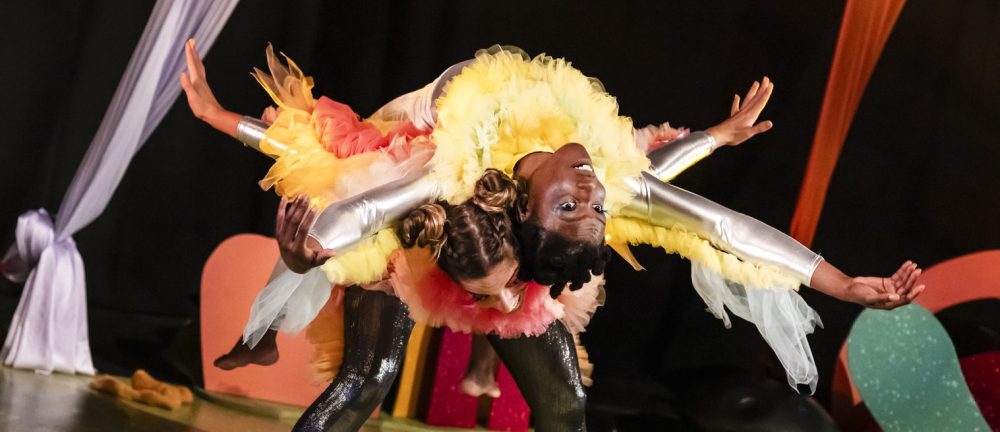
Take Flight is billed as immersive experience for 0–2 year olds — but it turns out adults are not immune to the sensory effects either.
London is an amazing place for theatre lovers — the choice so vast that FOMO eventually just clocks off. From the National Theatre to the endless variety of the West End, the incredible talent of the Young and Old Vic, and on into fringe and above-the-pub spaces… But there comes a moment in every editor’s life when you find yourself at 3 pm in a theatre hall near Limehouse, surrounded by a couple of dozen babies and their parents, all sitting on the floor on soft, bright cushions. I had invited a friend, Jessica, a new mum, to come along with her baby Cleon. They were late. So I stepped into this small, carefully constructed baby kingdom entirely on my own.

In front of us: two aerial silks hanging from the ceiling, wooden cut-outs of plants, and two actors in silver costumes with flashes of colour in their plumage, making soft, high-pitched sounds somewhere between birdsong and baby-directed speech. It looks slightly surreal, but for a reason: the play is aimed at babies up to two years old. And, as a very cheerful box office staff member tells me, it’s sold out. Looking at the foyer, packed with prams tighter than an Ascot racecourse car park in June, I have no reason to doubt it.
Take Flight, by Rebel Sparks, has been developed with input from developmental psychologist Dr Valentina Sclafani from the University of Lincoln, and the science sits underneath everything. There is, technically, a plot. A mother bird teaches her chick how to navigate the world: how to move, how to gather food, how to try, fail, and try again. You can tell who is who: the mother more assured, the smaller bird more tentative, occasionally chaotic. The play unfolds less as a continuous story and more as a sequence of moments — small, self-contained encounters that don’t demand sustained attention in the way adult theatre does.
The loose, non-linear structure, saturated colour palette, repetition of sound and movement, and abundance of texture might seem abstract to an adult, but are carefully calibrated to how very young children process the world. A baby’s brain forms more than 1 million new neural connections every second in the first years of life.

I watched one baby completely absorbed, eyes tracking the performers as they moved across the space, reaching out when a soft fabric “worm” was offered, while others shifted, vocalised, briefly disengaged, then returned. There was the occasional cry. Attention comes and goes at that age. The performers work with that, moving in and out of proximity, drawing attention back, shifting between observation and gentle participation as they pass through the audience
Slightly alarming to admit: I found myself relaxing to the point of almost meditative bliss, despite clearly physically sticking out and mentally preparing for the Hackney Art Week party scheduled for later that day. Somewhere between the slow aerial swaying, the soft guitar, and the general absence of urgency, my brain stopped trying to follow and simply settled into watching. Whether that says something profound about early cognitive development or just about the general state of an overstressed adult Londoner’s nervous system is open to interpretation.
After the show, I spoke to one of the performers, Rika Fujimoto, who plays the chick. Fujimoto trained as a clown and works in physical theatre, where words matter less than gesture and timing. She said one of the early concerns had been whether babies would stay with it at all. Watching them, it’s clear they can — just not continuously, and not on cue.
London often claims it has something for everyone — including audiences at the very beginning of figuring out how to see, hear, and engage with the world. And sometimes, adults who find themselves there by accident realise it works on them too.
The tour continues through June and early July, with dates across the country including London, Hertford, Sheffield, Ipswich and Prescot, before returning to London at Polka Theatre.
Back at Half Moon Theatre, the summer programme continues with work for slightly older audiences: Hopeful Monsters (19–20 June, ages 5+) and Rapunzel (25–27 June, ages 3+), before the venue pauses in August and resumes in September.
For more information about the tour visit www.reblesparks.com

Elena Leo is the Culture & Lifestyle Editor of Ikon London Magazine.


