
Review: The Spy Who Came In From The Cold, Richmond Theatre

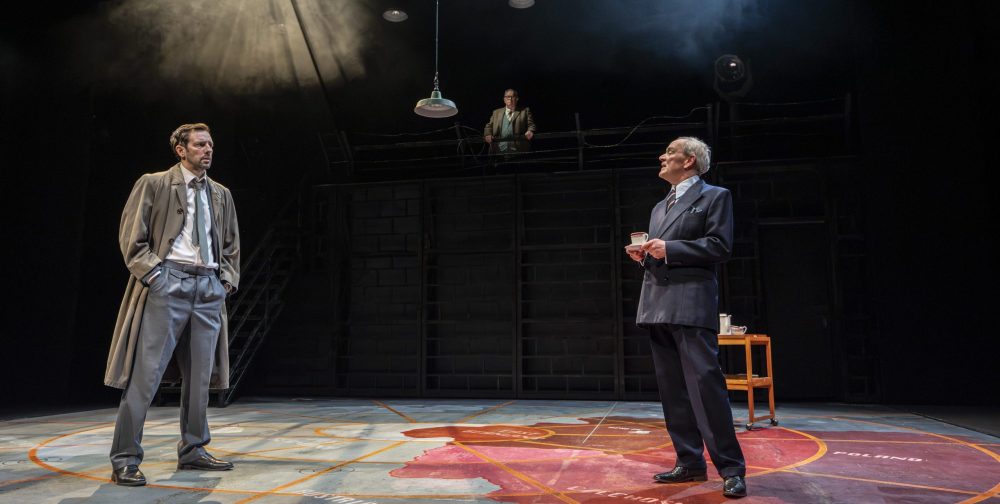
A Cold War classic arrives on stage with ambition, but struggles to translate its moral complexity into compelling theatre.
First published in 1963, The Spy Who Came In from the Cold marked a turning point for the spy genre. John le Carré, himself a former intelligence officer, stripped espionage of glamour and replaced it with a more realistic and cold labyrinth of compromised loyalties, quiet betrayals and close-ups of individuals caught in systems far larger than themselves. Later, this complex story, shaped by the aftermath of war, where ideology and survival blur into a tense abstract painting, was brought to the screen by Martin Ritt, with Richard Burton in the role of Leamas – le Carré famously sold the rights to Paramount for £9,000, not quite understanding what a “bestselling novel” is.
Now adapted for the stage by David Eldridge and directed by Jeremy Herrin, the novel arrives at Richmond Theatre as part of a UK tour. At its centre is Alec Leamas, a British intelligence officer drawn back in for one final mission – though, as ever in le Carré’s world, it is never entirely clear who is pulling the strings.

The material lends itself naturally to tension, perfect for a stage drama: shifting allegiances, moral compromise, the slow erosion of identity. But on stage, that intricacy proves difficult to sustain. The adaptation, as expected, streamlines the narrative, yet in doing so loses some of the density that gives the story its weight. Plot points are delivered quickly, often declared rather than dramatised, and it becomes surprisingly easy to lose track of who is doing what, and why. Actors given multiple roles to play, sometimes marked only by a quick change of a coat, do not help the narrative.
That sense of distance is reinforced by the pacing. Scenes move at speed, with dialogue carrying much of the burden, actors often racing through lines at something close to motorway speed. There is little space for silence or for tension to accumulate, and moments that should land with force – the violence of torture, the devastation of betrayal, the supposed clarity of revelation – pass without quite registering.

Ralf Little takes on the role of Leamas, a character defined as much by weariness as by moral ambiguity. It is a solid performance, but one that remains curiously restrained. The physical demands of the role are met, yet the emotional core feels less fully realised. Key relationships, particularly the connection with his love interest Liz Gold, never quite develop the chemistry needed to make their stakes convincing. And when an audience finds itself laughing during a waterboarding scene, it is probably not the intended effect.
Gráinne Dromgoole brings clarity and purpose to Liz Gold, a politically engaged young woman whose idealism stands in contrast to Leamas’s fatigue. Her presence and insistence on loving a forever runaway Leamas introduce the possibility of something more human within the narrative, though the relationship itself remains underdeveloped from an emotional point of view. It is hard to imagine why she would pursue him, and why he would eventually try to take care of her and spare her from the clutches of the intelligence machine.

There is stronger work in the supporting cast. Nicholas Murchie’s Control carries quiet authority, while Tony Turner’s George Smiley is particularly effective, embodying a calm, watchful presence that suggests more than it states. His positioning above the stage during certain scenes hints at a broader interpretive idea – observer, handler, perhaps even a projection of Leamas’s internal state – though the production never fully clarifies it, often leaving the effect more confusing than illuminating.
Visually, the production looks very assured. The set remains deliberately spare, with tables and chairs rearranged under stark lighting to suggest interrogation rooms, offices and transient spaces. Lighting creates a clear contrast between the warmer, more intimate scenes involving Liz and the colder, more impersonal world of intelligence work. One striking moment sees the back wall shift forward to form the Berlin Wall, a simple but effective device that sharpens the sense of division and lends weight to the play’s final act.
The production captures the outline of the story without fully inhabiting its complexity. It remains watchable, occasionally striking, but rarely as gripping or as unsettling as the material demands. Le Carré’s world is one of ambiguity, where truth is unstable and identity is constantly in flux. Translating that to the stage requires not just clarity, but control – an ability to let tension build and meaning emerge gradually. Here, that control feels just out of reach.
The Spy Who Came In From The Cold
Richmond Theatre
19 May – 23 May 2026
Running time: 2 hours 10 minutes including interval
Age guidance: 12+
Tickets here

Elena Leo is the Culture & Lifestyle Editor of Ikon London Magazine.


