
Fame, Ghosts, and the Ring of Fire: A Review of The Ballad of Johnny & June at Richmond Theatre

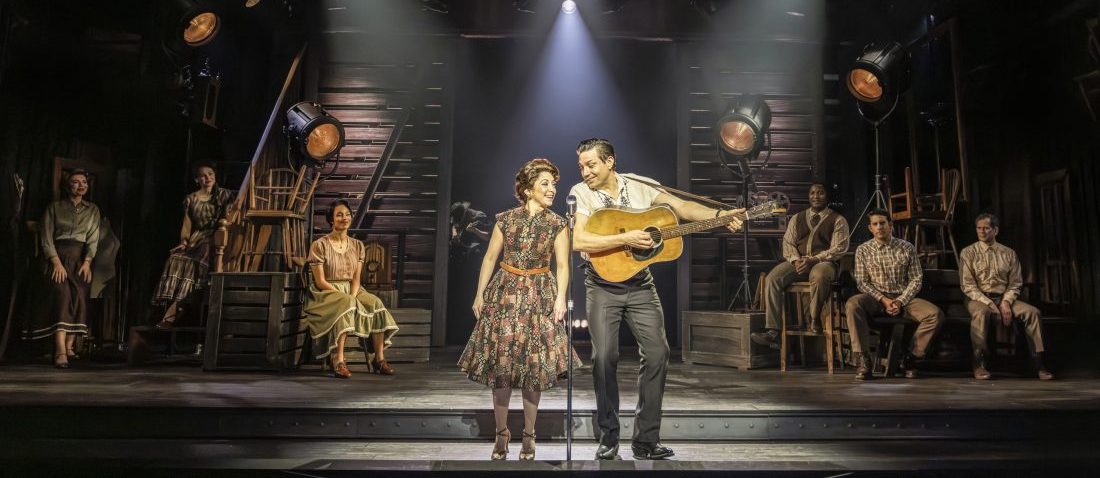
Christopher Ryan Grant and Christina Bianco anchor a dense, two-and-a-half-hour journey that refuses to sanitise the legend. Instead, the production plunges into the chaotic intersection of personal demons and musical genius, revealing how the trauma of a life on the road birthed the timeless anthems of the 20th century.
The Ballad of Johnny & June tells a story as old as time — a boy meets a girl, they fall in love, but with a few harrowing twists. He rises to become America’s most beloved “Man in Black,” a country and folk legend whose path crosses with a succession of women before he finally encounters The One. Yet, she has already met another boy. What follows is a turbulent interweaving of love, life, and fame, a tangled narrative that spirals through scandal and redemption until their final days.

The Plot
They are Johnny Cash and June Carter. Positioned against the explosive political and cultural landscape of the 1950s through the 1970s, their lives acted out on stage deliver not only phenomenal entertainment but also a poignant mosaic of American society across these transformative decades. Composed to life-defining music by Johnny, June, and others, the production is masterfully orchestrated by Ronnie Melrose and Joe Payne, weaving a sonic tapestry that mirrors the couple’s own journey — from scandalous affair to enduring legacy.
The production itself is a masterclass in pacing, navigating the tightrope between spoken drama and musical numbers with seamless fluidity. The score deftly blends the raw energy of rock-and-roll with the earthy roots of country, creating a soundscape that feels both nostalgic and immediate. Perhaps the most striking structural choice is the inclusion of a narrator: the couple’s son, John Carter Cash, played by Ryan O’Donnell. His voice guides the audience through the narrative, offering a unique, insider’s perspective that feels less like a performance and more like a family confession. It is a fitting touch, given that the real John Carter Cash serves as the show’s executive producer and story consultant, ensuring that the intimate details of his parents’ lives are rendered with a rare, authentic gravity.

He recounts his father’s upbringing in the struggling cotton fields of Dyess, Arkansas, where the family toiled under the shadow of a strict, alcoholic father — a complex man torn between harsh discipline and deep devotion. These formative years were shattered by the tragic death of his older brother, Jack, an event that unfolds in a heart-wrenching morgue scene, leaving young Johnny devastated as he makes a sacred vow to “keep his memory alive”.
Another storyline contrasts Johnny’s hardscrabble roots with the upbringing of June Carter, a daughter of country music royalty born into the legendary Carter Family. Performing on stage from a young age, she radiates upbeat energy and natural charisma, mastering the autoharp and comedy routines that made her a star. Yet, despite her professional success and fame, June feels trapped in a domestic rut, her vibrant spirit stifled by the expectations of a traditional marriage. Her husband and his friends look down on her career, insisting that a woman’s place is at home raising children, leaving June torn between the adoration of the crowd and the quiet dissatisfaction of a life that feels incomplete without her music.

The play’s non-linear timeline propels us from the couple’s electric first meeting backstage at the Grand Ole Opry to their quiet, sorrowful final days, with Johnny outliving June by merely three months in 2003. The script refuses to sanitise their turbulent history, laying bare the scandalous affair that unfolded while both were married to others, and the dark abyss of Johnny’s amphetamine and alcohol addiction that nearly consumed him. We witness the raw complexity of their bond: the danger of their early romance, the chaos of touring while battling demons, and the pivotal moment when Johnny’s TV show provided the stability they needed to finally settle down. It is a story of two broken souls finding salvation in each other, transforming a relationship born of guilt and chaos into a legendary, enduring love.

The Cast
Christopher Ryan Grant delivers a commanding performance as Cash, capturing the full, fractured spectrum of the troubled talent. He navigates the character’s deep-seated childhood traumas, spiraling addiction, and periods of debauchery with raw intensity, only to pivot effortlessly into moments of profound tenderness. Grant brings a formidable pedigree to the role, drawing on vast experience from the Broadway stage and the rock-and-roll circuit, having previously performed alongside icons like Jerry Lee Lewis and Little Richard. His physical transformation is equally convincing; he mimics Cash’s distinctive tics, gait, and the way he cradled his guitar with complete conviction. The musical selections further elevate the experience, with iconic tracks like “Ring of Fire,” “Walk the Line,” and “Jackson” given fresh life, alongside a haunting rendition of “Hurt.”
Christina Bianco is equally mesmerising as June Carter. While her role is steadier than her volatile husband’s, she infuses it with fierce emotional resilience and a distinctly Southern, grounded warmth. Leveraging the razor-sharp comedic instincts Bianco delivers a performance that is as hilariously sharp as it is deeply moving. She brings a fresh, audacious energy to the stage, her soaring vocals, accented by a sweet, rustic twang, creating a perfect counterpoint to Grant’s brooding intensity. Whether she stands with bold defiance against Cash’s addiction or reveals the vulnerability masked by her playful bravado, she proves to be far more than a supporting figure. Her solo in the comedic standout “No Swallerin’ Place” is a genuine showstopper, where her powerhouse delivery leaves the audience spellbound.

Ryan O’Donnell appears as John Carter Cash, a cheeky bard with a guitar and boyish charm. As both narrator and performer, he acts as the show’s structural anchor, his charming presence keeping the fragmented timeline cohesive and guiding the audience through the emotional turbulence with ease.
The ensemble surrounding him is incredibly talented, with Anne-Marie Wojna and Chomba S. Taulo earning special mention for their work as the spouses of Johnny and June. Both are gifted singers, but it is Wojna’s portrayal of Vivian Liberto that stands out as a thoughtful, heartbreaking study. She captures the tragedy of a woman who fell in love young, only to marry a rising star while staying behind to raise their children. Wojna embodies Vivian’s quiet strength and her belief in the sanctity of marriage, even as she is forced to endure the betrayal of a husband in the public eye, ultimately finding the courage to “sin” by walking away.

Visuals and Production
The production’s visual landscape is equally vital to its storytelling. Set Designer Robert Brill, Lighting Designer Amanda Zieve, and Projections Designer Sean Nieuwenhuis are paramount in establishing the play’s emotional depth. Brill’s set avoids the cliché of a simple cabin, opting instead for an intimate, cluttered barn aesthetic with weathered timbers and rolling slatted doors that swing open to reveal a hidden jamboree of on-stage musicians. This rustic, communal space is amplified by Nieuwenhuis’s projections, where flashing location names and newspaper headlines create a relentless, kinetic rhythm. Together, these elements mirror the breakneck pace of Cash’s life on the road and his roaring, often overwhelming, success, while the set’s warmth encourages the audience to step out of the theatre and into a shared, clap-along community.
Casting Director Serena Hill deserves credit for assembling this well-orchestrated ensemble of actors and musicians. The result is a production that delivers two hours of high-class entertainment, one that strums the full range of emotional chords and stands as a genuine showcase of theatrical excellence.
THE BALLAD OF JOHNNY & JUNE
Richmond Theatre, 7 to 11 July 2026
Tour continues to 19 September 2026
Tickets: https://www.atgtickets.com/shows/the-ballad-of-johnny-and-june/richmond-theatre/

Elena Leo is the Culture & Lifestyle Editor of Ikon London Magazine.


