
Vicky Krieps Speaks Her Truth in Cannes – And Beyond

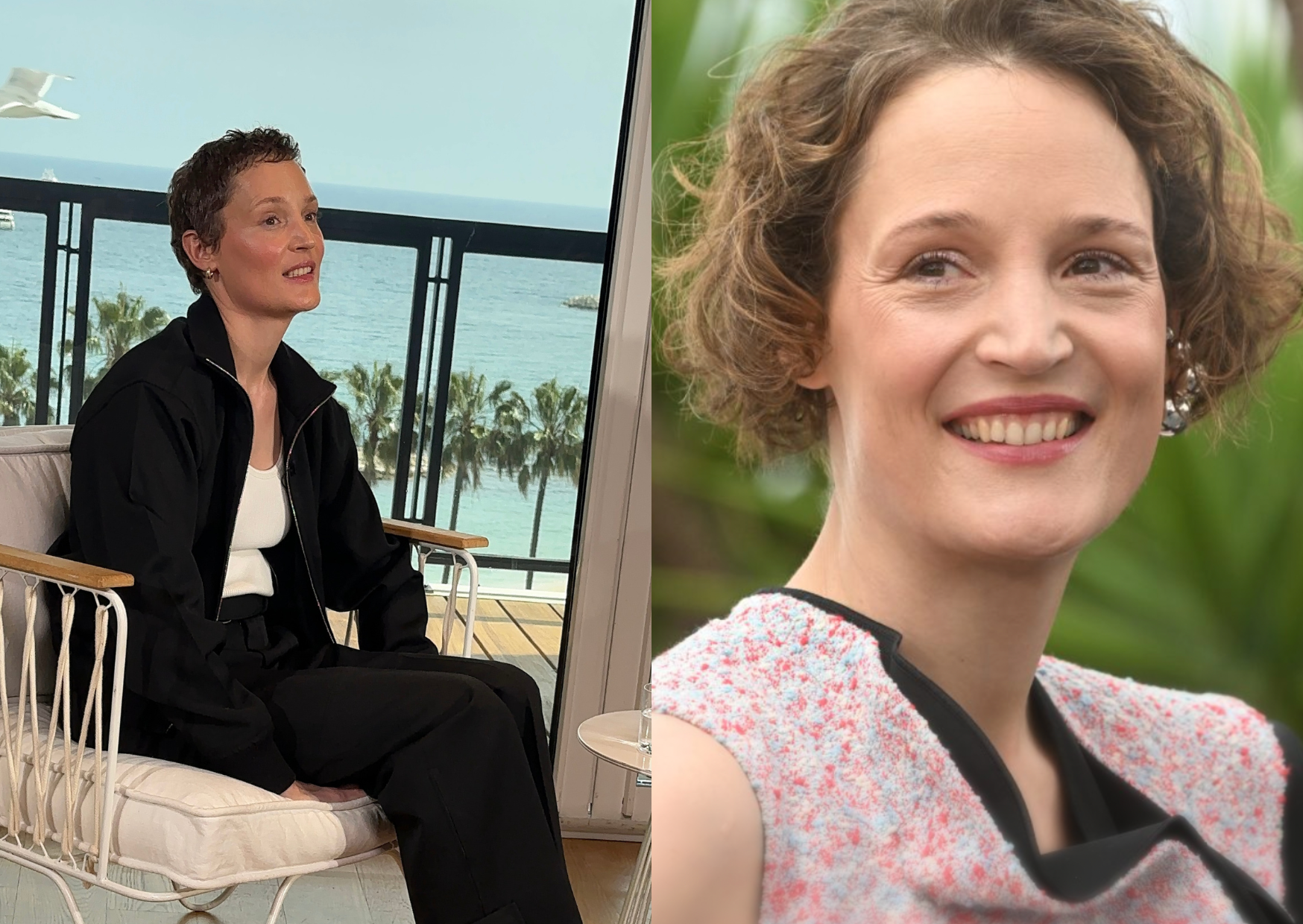
Luxembourg-born actress Vicky Krieps has carved her own path in cinema, from her breakthrough role in Paul Thomas Anderson’s “Phantom Thread” to her acclaimed performances in “Corsage” and now “Love Me Tender.” Known for her thoughtful approach to acting and life, Krieps has consistently chosen artistic integrity over industry expectations. In this candid conversation, she discusses her role as Clemence in “Love Me Tender”—a lawyer who abandons her wealthy lifestyle and faces custody challenges as a result—while reflecting on authenticity, motherhood, and the evolving landscape for women in film.
“We’re all expected to want more, to have the biggest apartment. But sometimes that’s not what we want, and we get punished for it,” reflects Vicky Krieps as she discusses her recent role in ‘Love Me Tender’. She portrays a woman who chooses to leave behind her wealthy lifestyle as a lawyer, subsequently facing societal judgment and custody challenges. “It’s like a video game that you play only once. She chooses what she wants to do, and she gets punished for it.”


When asked if she ever felt forced to follow societal expectations, Krieps shares her personal experience: “I was 27 and had children. I was told I’d never have a career. I was supposed to network, dress up, and talk to people—but I refused. I said, ‘I’ll maybe do movies that no one is going to see, but that’s what I want to do.’ I did one small film in Germany that nobody watched, but someone saw it and asked the casting director to invite me, as I wasn’t on the list.” She emphasizes, “Yes, the list exists in everything in your life. But you have a choice. Believe in what you’re doing, and you’ll always find your way.”
Krieps recalls her early connection to filmmaking: “When I was 16-17, we were a group of kids making movies, but I never wanted to act. I was preparing food. It was a horror film, and we were filming with real blood because we didn’t have fake blood. We went to a farmer and asked for blood. Then we’d go to a coffee shop, drink wine, and discuss films we just watched. That’s when I knew I wanted to be part of telling stories, sharing stories.”
Though she initially wanted to be a filmmaker rather than an actress, Krieps found herself drawn to acting. “I dared to do an acting school before embarking on something else in Luxembourg,” she explains. When asked about her father’s influence on her love for cinema, she responds, “In my mind, he was just going to work, working in distribution. It wasn’t any strong link to cinema. He had a smaller role in Luxembourg.”
Krieps deliberately chooses to work with women directors. “I love working with women,” she says, mentioning her collaboration on “Corsage” with Marie Kreutzer. “There is something that clicks, as if we both want to solve the enigma, the mystery—what it is to be a woman, what we are trying to produce.”
On her role as a producer, Krieps challenges established norms: “Until recently, there were only men producers, and I was told you can’t do production because you need to be accepted by a circle of producers. I said, ‘No, I’m just doing it.'” She explains her approach: “I try to help filmmakers find money, sometimes put people in touch. Maybe in the future, I would like to work on something I write.”
Regarding her potential move into directing, she notes, “The first time I was in Cannes, I was told I must do some directing because I already direct in the way I talk. I’ve had it in mind, but it’s a lot of work alongside having children—hard to combine making money for everyone and not feeling guilty. I noticed I had to start running twice as fast as men to make it.”
When asked if cinema makes it easier for women who want both family and work, Krieps offers a nuanced view: “Hard to say. I love Cannes. Last year I was in the jury. So we are heard, and we can exist. Someone like me can exist. Cannes is very important.” Yet she criticizes modern image culture: “At the same time, it’s like we have a disease—Instagram—that came like a tumor and eats us from the inside, and we can’t get rid of it. The image takes too much space and it’s not very interesting, so why do we do it? I really don’t care about Instagram. What’s important is what I think.”
On the topic of pay equity in the film industry, Krieps observes, “I believe we are still paid less, but it has become possible [to succeed]. When I am asked what I want to be paid, I say ‘whatever you want to pay me, I’m fine.’ But I exist, and that’s important. Before, someone like me would have had to do things to get ahead, and I never made compromises as a woman.”
Krieps feels a responsibility to represent women who remain unseen: “Also women who you don’t see, who are in the shadows and nobody knows they are there—we need to include them. I was very moved by that, and I think that’s what’s changing the focus.” She adds, “I always think practically only about the audience. Is what I’m saying the truth? Is it fair to these people? Because we don’t tell our story but theirs. Is it fair to their truth?”
Reflecting on historical female strength, Krieps shares, “Our grandmothers, mothers—they really held people in their hands and together during the war. They kept chaos under control; they held the fort.”
When confronted with the stereotype that outspoken women are labeled “hysterical” or “authoritarian,” Krieps responds, “When I speak, I speak with a lot of love, infinite love for this earth and for people, so I was never attacked for that.” She does recall one incident: “I felt it once when I was a student, at the end of my Bachelor degree. I grabbed the microphone from my teacher and said ‘thank you very much that I had an opportunity to learn my stuff, copy, and stay silent.’ It rapidly turned into a scandal. It was hard to be attacked in the press. It was very nasty.”
On the concept of “sorority” that emerged after the #MeToo movement, Krieps reflects, “I just discovered this word; I love it. Fraternity never struck me as a typically masculine word; I thought it applied to both genders. The sisterhood was always there.” She recalls childhood observations: “My grandma was sitting at the table, and men were shouting. When men left, I heard all the women start to speak. It was like a secret society that had been hidden. I realised then that it’s women who had the last word. It’s always been there, women supporting each other.”
Asked if cinema creates competition among actresses, Krieps acknowledges, “A bit. It’s fading away, but I felt that with some other actresses—sometimes physically. If she said ‘I’ll leave the movie’—pure competition, vanity—’I need to be the most beautiful one.'” She dismisses this mindset: “There is no ‘most beautiful.’ It’s like a plague, but you know in the bottom of your heart it’s not about beauty. Beauty is the contact, the connection. Appearance is just a lie, a way to put women in a prison so they can jeopardize themselves.”
Krieps believes in cinema’s power to deconstruct stereotypes: “I see it more in movies now. I wanted to shoot without makeup, and I was told I didn’t understand, that it’s about the light. But in ‘Phantom Thread,’ I decided to dare. I approached Paul Thomas Anderson to ask if he would allow me to shoot without makeup, as she’s a young girl. I said, ‘I don’t want any makeup, not even a no-makeup makeup.’ He promised, and they didn’t have the right to touch me.”
She describes the reaction on set: “I came to the set, and everybody was commenting that my skin was getting red. And that’s exactly what it was all about—a face that changes. It was a bit of a shock for people around me.”
Krieps concludes with a powerful statement about authenticity: “We shouldn’t be hiding. We should show ourselves as we are. When we do that in a movie, we show what real people look like. Same on social media—the faces aren’t real, all touched up. They look the same, like an army of faces. It’s a shame and not really interesting. So boring. We say about an actress who shoots without makeup that she is ‘bold’—what does it matter? We should allow people to be who they want. Men could do what they wanted, but a woman had to be something specific.”

Editor in Chief of Ikon London Magazine, journalist, film producer and founder of The DAFTA Film Awards (The DAFTAs).


