
An Ideal Husband review — upstairs at the White Bear Theatre

★★★★
A talented international ensemble brings clarity and energy to a lean adaptation that keeps Wilde’s social satire sharp without leaning on period decoration.
There is something deeply reassuring about a good pub. Brown leather Chesterfield sofas that forgive late nights. A stag’s head that has seen things. Wood panelling, low light, the suggestion that nothing much has changed here — except, perhaps, the price of a pint — and, crucially, that nothing much needs to. It’s a comforting idea. Places like this encourage a certain way of looking at the world: watching, listening, drawing conclusions about other people’s behaviour, small dramas unfolding in plain sight.
I’m not sure Oscar Wilde would ever have been caught in a pub — something tells me clubs would have suited this aristocratic, sharp-edged dandy far better — but, like the West End stage, fringe theatres across the UK (many of them sitting above pubs) have long been used to mount adaptations of his plays. And while Wilde’s comedies are set in drawing rooms, their real subject is social observation, hypocrisy and reputation — all things that survive perfectly well without chandeliers.
Which is why finding Wilde upstairs at the White Bear pub theatre in Kennington, stripped of upholstery and reassurance, feels not provocative but oddly right. This time it’s An Ideal Husband, first performed in 1895, Wilde’s most overtly political play, built around Victorian anxieties about morality, power, wealth and public virtue.
Wilde knew all about ideals — not because he believed in them uncritically, but because he understood how they were used. Lady Chiltern is a lucky woman, we are told: she believes she has married an ideal husband, a man of spotless reputation and moral clarity. Lizzie MacGregor portrays her with conviction rather than softness, someone who needs the world to be morally legible. German Segal plays Robert Chiltern with assurance, carrying the weight of the role with conviction despite being roughly half the character’s age; Chiltern has built his political career, marriage, and reputation on the belief in absolute moral integrity.
What only he knows — and what he profits from daily — is that the foundation of his success is built on a compromise made years earlier, one he has never paid for, except in fear. The arrival of the mischievous and calculating Mrs Cheveley threatens to uncover the truth and plunge both his career and marriage into chaos. Salvation comes in the form of his oldest friend, Lord Goring, a man who speaks almost exclusively in paradoxical epigrams and, in true Wildean fashion, manages to rescue everyone while appearing not to care very much at all. As in any well-made play of the period, the balance is restored — but only after the characters pass through a kind of purgatory of self-reflection and reassessment of their values.
Wilde’s joke is not that truth is muddy, but that we like to be principled with other people when we have better cards. Lady Chiltern herself, so fierce in her ideals, has no trouble bending her own rules when her husband’s reputation is threatened. Principles are admirable. Survival, it turns out, is a more persuasive insentive.
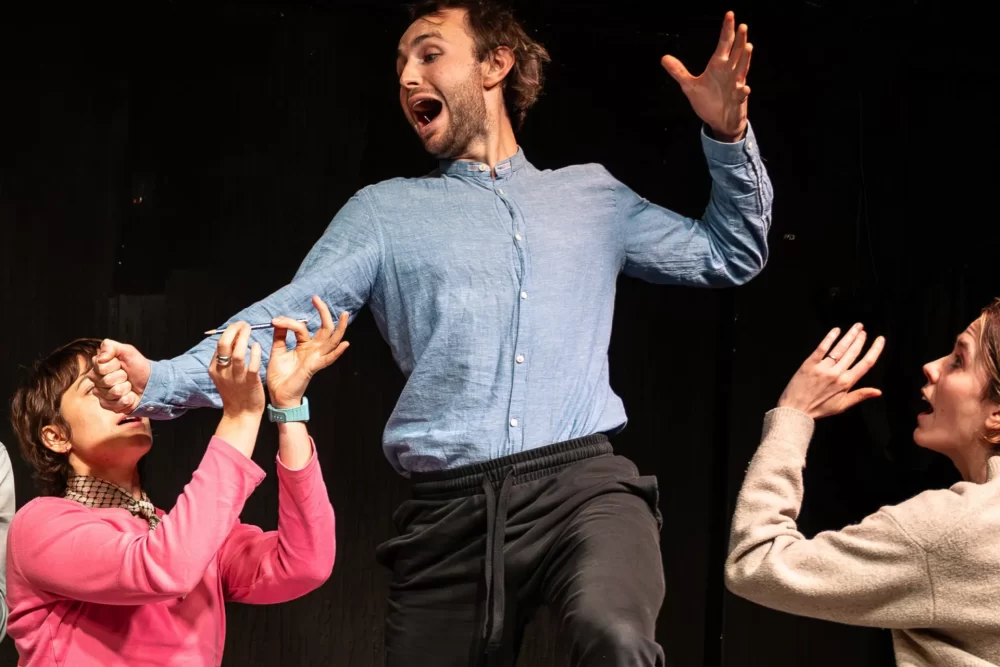
Directed by Ramin Gray, and produced by the newly formed Broken Nose Theatre, a company that blends British and European theatrical traditions, the production leans into this hypocrisy by refusing almost every comfort usually afforded to Wilde. There are no Victorian drawing rooms here, no elaborate costumes to reassure us that this all belongs safely in the past. Instead, the stage is a near-empty black box, sparsely accented with white plastic tables and well-worn blue office chairs — some of which are broken mid-play. Low-hanging bulbs, as if borrowed from a hip East London bar, detach themselves from the ceiling during the action. Actors appear in jeans, leggings and trainers, and initially with scripts in hand, as if we’ve wandered into a rehearsal rather than a finished performance.
It shouldn’t work.
And yet it does.
The production trims lines that have curdled with age — decisions made collectively by the cast during rehearsals — and sharpens its focus on what still bites: women’s autonomy, immigration, power, reputation and the brutal efficiency with which society forgives people who generate wealth. The result is not a frantic attempt to update Wilde, but confidence that his satire still carries weight once period furniture is removed.
The first act stays fairly still. The actors sit behind a row of white tables, scripts in hand, as if the play is still being figured out. Then it loosens. In the second act, they begin to roll across the stage on office chairs, spinning, chasing one another, and letting physical comedy open things up further.
At the centre of the chaos is Lord Goring, played by Michael Tcherepashenets, who turns Wilde’s dandy-observer into something more functional and more human. Dressed in a cowboy hat and black sunglasses and speaking in a Texan drawl, he initially presents as a committed cynic, dismissive of moral seriousness and material virtue alike. Gradually, paradox and epigram give way to an insistence on understanding, charity and forgiveness.
Opposite him, Anastasia Velikorodnaya’s Mrs Cheveley is a pointed triumph. A woman with a past — a familiar obsession in Wilde’s world — she is sovereign in her actions, even when those actions are morally dubious. She behaves exactly as the men do: strategically, opportunistically, without sentiment. The difference is not method, but permission. Velikorodnaya plays her with a precise mix of sarcasm and mischief — a smirk held at the corner of the mouth, a slight arch of the eyebrow — fully aware of how power works and intent on using it. If Robert Chiltern is allowed to build his fortune on a moral compromise, it is not immediately clear why she should not attempt the same.
Lady Chiltern has the hardest journey. MacGregor charts her movement from idealistic rigidity through indignation and grief towards something less tidy but more compassionate and realistic. Wilde’s question is not simply whether ideals survive contact with reality, but what remains of love and marriage once certainty collapses.
The supporting roles are sharply drawn. Annie Tyson’s Lady Markby, delivered in crisp RP, convincingly portrays a retrograde guardian of how things should remain. Her monologue on immigration is especially timely, landing with particular force within an international cast. Cosima Aslangul’s Mabel Chiltern leans fully into an exaggerated French accent, all ingenuous enthusiasm — like a gleefully chirping bird at five in the morning on a sunny day. By contrast, John Rice’s Lord Caversham has such a naturally soft, almost innocent face that it’s hard to imagine him scheming in Parliament or holding a hard line on anything at all, even as he delivers lectures on productivity with the conviction of a life coach selling an efficiency course after a free webinar.
The cast is strikingly international — Russian, French, Irish, English and American — and Gray leans into it rather than sanding it down. Accents are not disguised and are sometimes exaggerated. Robert Chiltern, the embodiment of English respectability, speaks with a soft Russian accent; his sister Mabel with exaggerated Frenchness. Does it matter? Not at all. Respectability, after all, has always been a performance.
Downstairs, the pub remains warm, familiar and reassuring. Upstairs, an international cast reminds us why ideals are dangerous things — and why, without mercy, they are difficult to live with.
Oscar Wilde’s An Ideal Husband
Dates: January 5–11, 2026
Venue: White Bear Theatre
138 Kennington Park Road, London
More info: https://www.whitebeartheatre.co.uk/

Elena Leo is the Culture & Lifestyle Editor of Ikon London Magazine.


