
Rose Wylie: The Picture Comes First — Royal Academy Exhibition Review

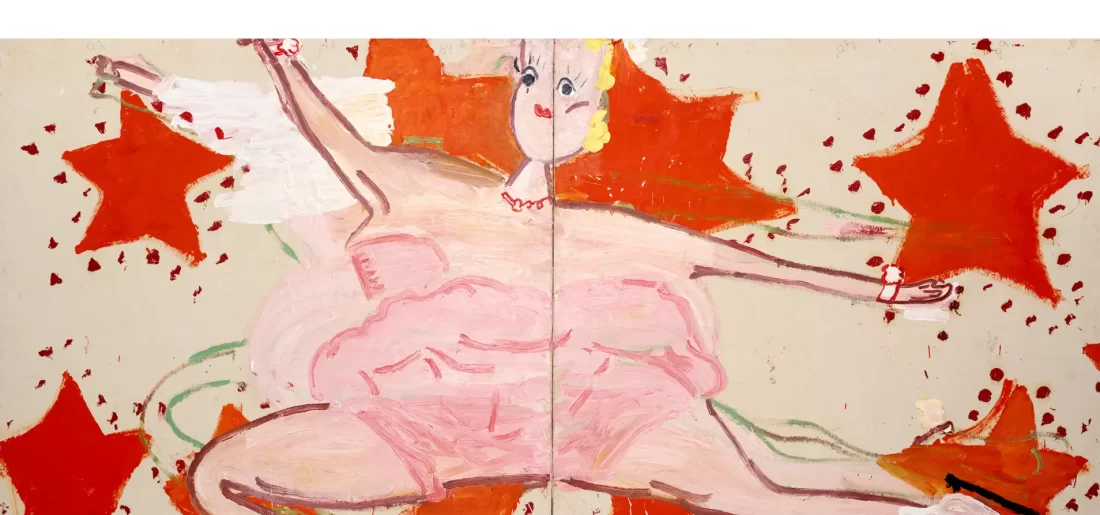
Rose Wylie’s exhibition The Picture Comes First brings more than ninety paintings and drawings to the Royal Academy, tracing a practice shaped by memory, film, newspapers and daily life.
Rose Wylie has filled the Royal Academy’s main galleries with more than ninety paintings and drawings. At 91, she is the first British woman painter to have a solo exhibition in these rooms. The delay says something about the institution as much as it does about her career. Once inside, though, it is the work itself that sets the tone — its scale, its clarity, its odd humour. Canvases run almost the width of the walls, figures lean and tilt across them, words are written directly into the paint, and areas of raw canvas are often left exposed.

Snowwhite (3), with Duster, 2018. Oil on canvas. 183.5 x 320 cm (overall). Private collection. © Rose Wylie. Courtesy the artist and David Zwirner. Photo: Jo Moon Price
She first trained in the 1950s at Folkestone and Dover School of Art, studying anatomical drawing and figurative painting. After marrying the painter Roy Oxlade she stopped painting for many years while raising their three children. In her early forties she returned to study, completing an MA at the Royal College of Art in 1981; her dissertation focused on the language and status of drawing. For some time the work developed quietly. One of the first bodies of paintings to attract wider attention was Room Project (2002–03), a group of large canvases in which cats, paper dolls, Olympic swimmers and figures from Wylie’s own life drift across expansive surfaces. The paintings already show the scale and looseness that now fill the Royal Academy galleries. Recognition came slowly, and quite late. Her work appeared in Women to Watch at the National Museum of Women in the Arts in Washington in 2010, which brought renewed attention to overlooked women artists, and a few years later the international gallery David Zwirner began representing her, introducing the paintings to a much wider audience through exhibitions in London and New York. By that point the visual language was already firmly in place — flattened space, enlarged heads, deliberate shifts in proportion and a surface that remains visibly worked rather than polished.

The exhibition opens with paintings drawn from Wylie’s childhood during the Second World War. Born in 1934, she lived in Kent and in London’s Bayswater during the Blitz, and those memories return here in concentrated form. In Rosemount (Coloured), the family home that was struck by an incendiary device appears as a dark, compact block, its name painted across it in red. Above it, a thin line traces the path of a V1 flying bomb — the “doodlebug” whose engine would suddenly cut out before impact. Two small dogs move along the lower edge of the canvas, their legs simplified, almost clipped into place. In nearby works the doodlebug returns, shifted slightly, set against different grounds, as if she is testing the image again and again. These early memories recur throughout her work.

Drawing runs quietly through the exhibition. Sheets of paper show quick ink sketches, coloured-pencil figures and repeated attempts at the same hand or face. She draws every day, often on whatever paper is nearby. Some drawings remain as they are; others lie dormant for years before reappearing inside a painting at monumental scale. An ancient Babylonian relief encountered at the British Museum was first recorded in a drawing without knowing its full story. Later, after hearing Lilith mentioned in Wim Wenders’s documentary on Anselm Kiefer, Wylie returned to the image. It appears in Lilith and Gucci Boy (2024), where the winged female figure associated with the so-called “Queen of the Night” plaque stands beside a contemporary fashion image, the words “the first feminist” written across the surface.
Film appears frequently in the middle galleries. In the Film Notes works, remembered fragments from cinema move onto canvas. Wylie has spoken about being drawn to close-ups and cropping, and you see that in Kill Bill (Film Notes), where a single frame from Quentin Tarantino’s film is replayed from slightly different angles. She is less interested in the plot than in the image itself — a single shot lifted out and looked at again. The upturned arm and the flash of red remain, pared down to their graphic impact. In Bagdad Café (Film Notes), a character from Percy Adlon’s 1987 film occupies one side of the canvas, while red lips licking a coffee spoon and flowers against a calendar page appear beside her.

Kill Bill (Film Notes), 2007. Oil on canvas. 180 × 308 cm (overall). Courtesy private collection and JARILAGER Gallery. Photograph courtesy Jari Lager. Photo: Soon-Hak Kwon. © Rose Wylie
Newspapers and online images provide another stream of material. Wylie studies press photographs for their visual charge — a red-carpet gown, a footballer mid-stride, a couple caught in scandal. In A Handsome Couple (2022), based on an image of the Duke and Duchess of Argyll, she focuses on the Duchess’s three-strand pearl necklace, the detail that identified her during the highly publicised 1963 divorce case. The couple stand upright, almost stiff, the title written plainly across the canvas. The painting stays close to the surface impression of the photograph.
Personal material appears just as readily. Seating plans from art-world dinners become canvases filled with black initials marking who sat where. Meals with friends, objects from her house and the presence of her cat Pete slip into view alongside film stills and press images. A doodlebug, a fashion photograph and a dinner arrangement end up sharing the same surface.
The final room holds four large monochrome animal paintings in saturated ginger, black, blue and red. The paint was applied directly with her hands. Up close, you see where pigment has been pushed and thickened, where it thins across the canvas and where earlier passages have been scraped away and worked again. The animals are easy to recognise, though the surface keeps pulling your attention back to the paint.

Bird, Lemur and Elephant, 2016. Oil on canvas. 183 × 499 cm (overall). Courtesy private collection and JARILAGER Gallery. Photograph courtesy Jari Lager. Photo: Soon-Hak Kwon. © Rose Wylie
Moving through the galleries, the work feels continuous rather than retrospective. The scale remains expansive, the proportions slightly askew, the imagery drawn from wherever Wylie’s attention settles — wartime memory, cinema, newspapers, the garden outside her studio window. She still draws every day and paints late into the night in her Kent studio, returning to the same images and trying them again.
For Wylie, as the exhibition title suggests, the picture still comes first.
The Picture Comes First runs at the Royal Academy of Arts in London from 28 February to 19 April 2026.
Tickets and information: https://www.royalacademy.org.uk/exhibition/rose-wylie
Featured Image: Pink Skater (Will I Win, Will I Win), 2015. Oil on canvas. 208 × 329 cm (overall). Courtesy private collection and JARILAGER Gallery. Photograph courtesy Jari Lager. Photo: Soon-Hak Kwon. © Rose Wylie

Elena Leo is the Culture & Lifestyle Editor of Ikon London Magazine.


